The Great Question(s)…

Well actually it is not the great questions but more the great types of questions. We will leave the list of great questions for the philosophical blogs, not the ones on consulting excellence.

The type of question is more important to the excellent consultant. Lets look at some example questions.
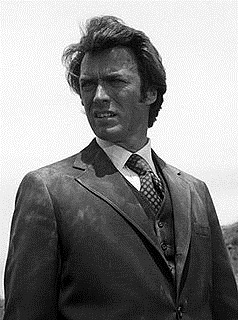
clint-eastwood-dirty-harry

Clint Eastwood playing Dirty Harry. He chases down a criminal, points his gun at him, challenging him to a shoot-out and says “Do you feel lucky punk? Well do you?”. In consulting terms we would refer to this as an implication question. The implication in this case being a life or death answer to the question.

Perception questions get your client to talk about what they are thinking about a subject. Take a pointer from “The Longest Yard”. Burt Reynolds plays Paul Crewe , jailed for car theft, but really shunned for when he was quarterback of an NFL team, throwing the game.,

Paul Crewe: You take your football down here real serious, don’t you?
Caretaker: You mind if I ask you one question?
Paul Crewe: Yes, I do mind!
Caretaker: Why did you do it?        (Perception)
Paul Crewe: It’s a long story.
Caretaker: Well, I got eight years.
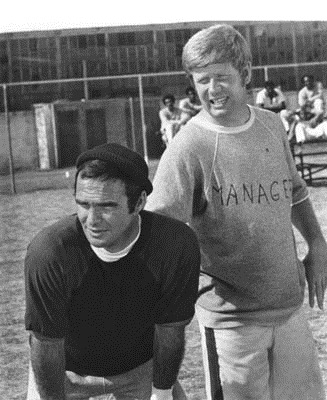
caretaker

Exploring. Just to prove that I don’t just watch “guy-flicks”. Sleepless in Seattle – Tom Hanks as Sam Baldwin.

hanks

Doctor Marcia Fieldstone: Tell me what was so special about your wife? (exploring)
Sam Baldwin: Well, how long is your program? Well, it was a million tiny little things that, when you added them all up, they meant we were suppose to be together… and I knew it. I knew it the very first time I touched her. It was like coming home… only to no home I’d ever known… I was just taking her hand to help her out of a car and I knew. It was like… magic.

Commitment Questions.

PrettyWoman_PWC-1_L_None_wide_onecolumn

In the movie “Pretty Woman”, Richard Gere plays Edward Lewis. In the scene where he asks the store manager (Hollister) for some special attention to be paid to the Vivian Ward played by Julia Roberts.

Mr. Hollister: Just how obscene an amount of cash are we talking about here? Profane or really offensive?  (commitment)
Edward Lewis: Really offensive.
Mr. Hollister: I like him so much.


Questions…..

· Give you control during the meeting    (see my blog on Consulting Lessons from Goldie Hawn )

· Focus you on the client’s interest

· Give you time to listen carefully

· Provide the information you require

There are two primary categories of questions. Opening and Closing. The goal is to learn when to use the correct type of question!

Three Types of Opening Out Questions

Fact-finding Questions

  • When is the deadline?
  • What are the business objectives?
  • How many sites are in the network?
  • Where are they located?

Note that these are open questions that cannot be answered by a yes or a no. Be aware that if you ask too many fact-finding questions one after another – the client will feel as though he or she is being interrogated. Using too many of these questions leads to:

  • One-sided conversations
  • Embarrassment if the client does not have all the facts
  • The inference that you have a solution if you can have the facts

To avoid these traps:

  • Intersperse your fact-finding questions with exploring and perception questions
  • Establish a balanced, conversational style

Exploring Questions

  • Why did you choose that particular sequence?
  • What caused you to reject the original plan?
  • When did the problem arise?
  • How difficult do you see the design task?

These questions uncover underlying issues. They involve the client and encourage a deeper understanding of the situation.

Perception Questions

  • What do you think about?
  • What is your opinion?
  • Where do you see the benefits?
  • Does ….. share that view?
  • What is …..’s opinion?

These questions establish attitudes and opinions. They reassure the client that his or her viewpoint is considered and important.


Three Types of Closing Down Questions

Implication Questions

  • What effect will that have on the system?
  • What does that represent in lost revenue?
  • Will that mean taking on more people?
  • What effect will that have on security?

These questions help test options and possibilities. They also help the client and the consultant clarify the particular situation and the hidden costs of doing nothing

Added-Value Questions

  • In summary, where do you see the added value of this new approach?
  • What might be the benefits of X? For you? For others?
  • What profit improvements are you looking to achieve?
  • What business improvements do you see in this application? Increased customer service? …..Improved job satisfaction?

Use these questions to highlight the value of options and possible solutions.


Confirmation and Commitment Questions

  • I get the impression that you view is ….. Am I right?
  • The main issues I have noted are these ….. Am I right?
  • Would you add any other alternatives?
  • Do we have a common understanding of ….?
  • Can I say in my report at you support this alternative?

Use these questions to check your understanding, and to gain explicit agreement and support.


One of the most important techniques I have ever learned is to plan every meeting with a series of questions before I attend. I always categorize them as open and closing question. Open questions I use early in the meeting, closing I use towards then end of the meeting. The goal of each is to have a conclusion that is agreed to and committed to.

Learn how to ask the right questions.

What do you think about that?
Posted in Consulting Excellence | 5 Comments

What’s the difference between a Janitor and an Enterprise Architect?

“What’s the difference between a janitor and an enterprise architect? If the janitor stops doing his job, eventually someone will notice.”

“EA’s are the guys who program in PowerPoint."

“We’re okay now, we just hired a TOGAF certified architect as our EA”.

The last one is certainly the biggest joke of the three. I must commend the entrepreneurial spirit of some training vendors though. I recently saw the following statement in an advertisement for a 4-day long TOGAF certification course. “Become an architect in 4-days for $X,XXX!”. TOGAF has improved, expanded and updated on Zachman, is relevant to SOA. complementary to others and is a worthwhile investment of an extra-long weekend for some. It does not however make you an architect. So the people who walk up to me and say “Hi , I’m Jim, I’m TOGAF certified” I think they are a little confused.  What I heard when they said that was “Hi , I’m Jim, I went on a 4-day course recently”. It really didn’t impress me and I always ask them if their course was at least in a tropical location. A quizzical look normally follows.

Now the course is good, some of the TOGAF masters I have met actually deserve to be called that but the certification means you took the course and passed. That’s all.

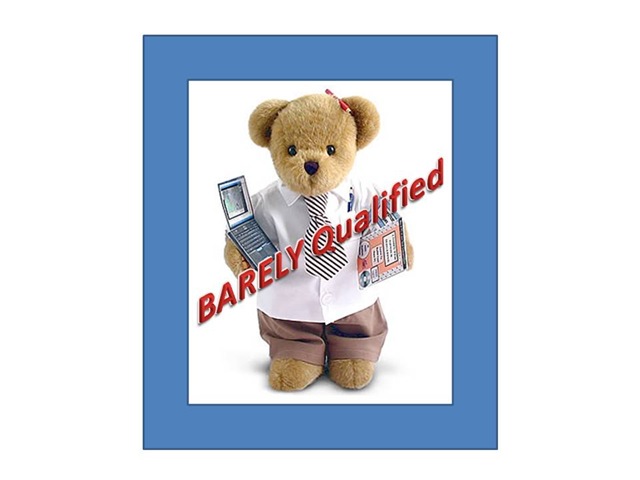
So I have decided to start a new certification process. It is the “Best Architecture Reference Evaluated Last Years” certification, so architects can be BARELY qualified.

Now this approach has two benefits.

1) For prospective clients it provides some sense that an architect has been evaluated by their peers, has actually done some real architecture work (other than on a 4-day course) and it is current (last few years).

2) It’s funny.

  • “Hi, I’m Chris. I’m BARELY qualified for this position.”.
  • “we’re looking for candidates that are BARELY qualified” ,
  • “applicants that are BARELY qualified are preferred”

Track record is what counts. I think a certification process that reviews your work, reviews the results of your work, reviews the business benefits of your work might be a more valuable certification. Maybe you could be BARELY qualified too. You’ll get a cool logo for your business card too!

barely_qualified

Posted in Consulting Excellence | 1 Comment

Playing Favorites, Jumping to Conclusions and other Idioms

With the amount of jumping to conclusions that consultants do, you would think we would be the fittest occupation on the planet.

“Few people like problems. Hence the natural tendency in problem-solving is to pick the first solution that comes to mind and run with it. The disadvantage of this approach is that you may run either off a cliff or into a worse problem than you started with. A better strategy… is to select the best path from many ideas or concepts.” – James L. Adams, Conceptual Blockbusting

 con_block

An inexperienced consultant tends to see only the parts of the problem that his or her favorite solution can address. Then, in a rush, they force the problem to fit their favorite solution. ( I am a Sharepoint consultant therefore you need this in a Sharepoint List with Workflow! or I am a C# developer so you need an custom ASP .NET application for this!)

This rarely works successfully and the results can be disastrous and can then lead to:

  • Total failure of solution
  • Resistance from client
  • Total breakdown of relationship with client
  • Loss of a customer
  • Disintegration of both the consultant’s and related firm’s reputation

So how do you prevent this from happening?

Stick to the consulting process and don’t miss steps. A critical step in every engagement is envisioning. What are the possibilities? Your first conclusion may be right, but it may not be either. Worst case, it is better to find out now that your technology choice/skill set isn’t the right answer, than 2 months from now and the client is now angry. Take a look at the options and evaluate it, every time.  You can influence your client to spend a little bit of extra time up front just to make sure that the direction you have chosen is in fact either the best solution or at least an acceptable one to meet their goals.

Let me provide an example.

In my blog A double cheese burger, extra large fries, and a small diet Coke I described a scenario where a consulting group jumped to a conclusion. They sold high availability solutions, therefore that is what their client “needed”. The symptom was a sporadic outage and the conclusion was “you need HA”.  Now let’s look at this problem from a real envisioning exercise that is literally only an hour or two in length.

The problem space – what are the pieces and what do we see?

outage

The analysis – putting some structure around the potential causes and associated answers

outage2

It takes very little effort to do a little envisioning on every engagement. What are the things that are not immediately obvious?

If you walk through it with your client and they eliminate items from scope, That’s fair. But if you never give them opportunity to have an opinion about it, that’s bad consulting. Very bad.

In this example, this issue was not resolved by the implementation of a $1 Million High Availability infrastructure because the consultants were:

Playing favorites, jumping to conclusions and the last idiom…. barking up the wrong tree.

barking

Posted in Consulting Excellence | 1 Comment

The three faces of consulting

illusion_41

A great consultant is not two-faced but three-faced. In the above picture you should see a young lady, an older lady and a man with a mustache. It is still one picture though. A great consultant needs to be able to adapt to his or her client’s preferred consulting model.   There are three possible models for any engagement.

Expertise Model

expert

This model is task based.  For this model to work effectively your client must have:

1. Diagnosed the problem correctly.

2. Correctly identified your capabilities to provide the service.

3. Correctly communicated to you the problem and the nature of the expertise required.

4. Thought through and accepted the potential consequences of defining the problem and service themselves.

Example: The client wants database performance optimized. They have therefore decided it is a database not application problem, they have decided the areas that could be optimized and they have decided that the right skill set is a database internist who will change configurations to get better performance. They have also decided how long this exercise will be and set expectations for the amount of improvement that can be gained for the time and money invested. They have no expectation that you will identify and assist with anything beyond the scope of work defined.

Doctor-Patient Model

doctor

The client can describe symptoms of a problem that have led them to believe that something is wrong. The have trust that by engaging the doctor that you will correctly identify the root cause and make the symptoms go away, however that is accomplished.

For this model to work effectively the following criteria must be true:

1. The diagnostic process must be seen as helpful and the client must let you do it.  They must not want just the symptoms treated.

2. Your client must have correctly identified the sick area.

3. The people in the sick area must be likely to reveal information relevant to making a valid diagnosis.

4. Your client must be able to understand and correctly interpret your diagnosis and be able to implement your prescription/advice.

Example:  Staying with the example above. The client has slow performance for it’s end-users. It could be network, application, database or middleware related. The client can identify symptoms. (“This transaction takes 10-15 seconds”) They have described the symptom but indicated to you “Doc, I need this application to go faster in the 1-3 second range for those transactions”.  The client will provide access to network, application, database, middleware people and resources required to do a diagnosis and just want it fixed.

Process Consultation Model

consultation

For this model to work the following assumptions must be met:

1. Your client is in pain and does not know the source of the pain or what to do about it.

2. Your client does not know what kind of help may be available or which consultant can provide the kind of help that may be needed.

3. The nature of the problem is such that your client needs help to figure out what is wrong and will benefit from participating in making the diagnosis.

4. Your client is motivated by goals and values that you respect and will accept your help.

Client – Consultant Model Challenges

Many consultants work in an “Expertise” model only. They expect to be told what to do, when to do it and have no stake in overall success of the client’s endeavor. If it fails, it wasn’t within their scope or control.

Here are some classic model failures.

  • The client has a performance issue and incorrectly diagnoses the problem as being a database optimization issue. The consultant is engaged, optimizes what is possible and the overall system performance is still poor.  A doctor-patient or process consultation model may have been a better model.
  • The client identifies that they are “sick”, performance is bad. The consultant only offers to tune the database.
  • The client wants to work with the consultant to work through the problem but the consultant just wants to “fix-it”.

Mismatches in models can easily cause any engagement to fail, no matter how technically skilled the consultant is.

In addition to what you know, the client is even more concerned over how you work with them.

Learn how to discern how your client wants to work with you.

Posted in Consulting Excellence | 1 Comment

Watching for the signs of project trouble…

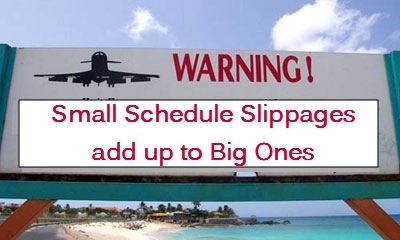
You are on the beach in the tropical isle of St. Maarten. It is surprisingly quiet. In fact you seem to have most of this part of the beach all to yourself. Until ..

061709_0638_10MostDange5 

you find out the reason, it’s so uninhabited. Now how did you miss that sign?

st-maarten-airport-sign

Well the fact you can afford the time for a nice vacation in St. Maarten is a good sign or are you there because you errantly think you can afford the week off?

Did you miss any other signs recently?

st-maarten-2

Here are some of the real signs everyone on a project needs to look for as early-warning signs of trouble:

  • Is management direction inconsistent or missing?
  • Has the project leadership gone AWOL?
  • Is there anyone on your team unable to articulate the project’s goals?
  • Project management and business management seem disconnected?
  • The team lacks a commitment to clearly articulated and commonly understood goals?
  • Team members don’t listen to one another?
  • The team is in a state of discord?
  • Lack of Velocity?
  • Increasing number of small slippages?
  • People willing to trade quality off for schedule?
  • Resources are being temporarily diverted to urgent matters?
  • Limited stakeholder involvement and/or participation?
  • Team members lack requisite knowledge and/or skills?
  • Subject matter experts are overscheduled?
  • Weak change control process?
  • Project Status reports puzzle you?

So let’s assume you are on a project in a technical role and a number of items on the list above have occurred on the project. You have 3 options:

  1. run away 
  2. do nothing and keep billing until it blows up
  3. be part of the process to fix it

We would all like to be on projects where the Lead Project Manager is a genius. I have been on some of those projects and I have led some (:>). However, more often than not, your lead PM is imperfect and has in fact let some, many or all of the items in the early-warning list start to happen. The good news is if you really have been watching and it is in fact early in the process, most if not all of them are correctable. So let’s be part of the process to help fix it.

Propose activities to your PM to fix the trouble areas:

  • regularly scheduled team sync meeting, ensure that the first one has crisp vision, goals and objectives for the project. Nobody leaves the room until everyone has bought in and agrees on the big picture.
  • team overhaul of the schedule and give your PM some proactive trade-offs they can offer.
  • have team members contribute sections to the status reports
  • offer to have stakeholder “brown-bag” lunch sessions to get 1:1 and 1:N face time with them to discuss challenges
  • buy the SME’s and/or stakeholders breakfast, lunch or dinner. Make more hours available to talk.
  • provide off-schedule crash course technical training to team members where required – call it Advanced Features Review instead of remedial though
  • regardless of the formal organization structure, leverage your senior experienced resources to be key design and PM influencers
  • have your senior resources take responsibility for communications to their individual team areas
  • make process change recommendations where required
  • leverage your informal communication network to address issues
  • help your PM understand impact of changes
    • get the team to consolidate it
    • manage your own CM
    • make sure the impact and risks are reported to the PM in a pre-fab manner they can send forward without interpretation.

If it is done properly and professionally, the PM will appreciate your efforts. You can be a coach and valuable resource to them as well.

The end goal is always project success for your client.

I recently saw the following presented as the qualities of a good project manager.

management-qualities

However I was not certain why being able to chart and write letters backwards on glass should be the PM quality I would first look for.

I’d rather have one that didn’t cause all the early-warning signals to go off.

Posted in Consulting Excellence | 2 Comments

5 “Consultants” and Behavior you won’t believe.

If you have been reading my consulting excellence blog you will note that I have a high degree of passion for the profession. I cherish the attributes of skill, professionalism, intellect, integrity, teamwork and action. Not all consultants are successful at illustrating these attributes.  I have the true stories of 5 consultants that may give you some insight as to why client’s are sometimes wary of engaging consultants.

Person #1

generate-income 

Person #1 a Requirements Analyst showed up for work every morning at 8:15 am. He would doff his coat, power up his PC, remove his glasses and head off for his first meeting of the day. Or so we thought. Actually he did all that except attend his first meeting. He left the building and headed for another office to go to his 9:00 am job. Fortunately for him, the offices were close by and he could attend mandatory meetings in either location without much fuss. At his second location, he would leave yet another pair of glasses, another warmed up PC and another coat on the rack. He would effectively split his time between both jobs during the day, do half the work he was tasked with and receive double the compensation. His work quality was actually reasonably high but not voluminous, he would run behind schedule but find creative ways to book client meetings out in advance and claim the client wasn’t available in the short term. It wasn’t until one of these slippages was challenged in a steering committee meeting that the fake client unavailability claim was exposed. A cursory check then revealed that he was gone off-premise 1/2 of the day. When presented with the facts about his off-premises time, he admitted to the scam. He had only been on our project for about 60 days, but in conversation mentioned that he been “double-timing” for over 10 years and no one had ever complained. We, unsolicited, refunded all his time billed to the client and withheld payment of all invoices he submitted.

Person #2

television

Person #2 was a Technical QA specialist on our team. It is very, very hard to judge the productivity of Tech QA resources, because they only report things that are failures. Nothing to report is good news. If the volume of Tech QA bugs is low, everyone is happy.  So it’s a perfect place to hide on a project. Person #2 was one of a large team of technical quality assurance resources.  They work mostly alone on assigned areas and for the most part if they report bugs, you know they are working. Person #2 however his hobby was Tech QA. A hobby he was paid for unfortunately. His real job was a stock day-trader.  He would “work” impressive numbers of hours, mostly coinciding with Nikkei and FTSE as well as North American markets. We did permit personal use of the network for our consultants and contrary to popular belief, did not spend much time reviewing the URL traffic. He may never have been caught except… he went on TV. As part of a local business program, they did a story on day-traders. There he was, not only explaining the benefits of day-trading but also saying that his day job was really interfering with his day-trading. He didn’t have that problem the next morning. We, unsolicited, refunded all his time billed to the client, pulled the Network logs, added up up the time and sent an invoice to the agency that brokered him for all his time spent on non-client business. It was 100% of his time.

Person #3

stack-diapers

Person #3 was actually a competent consultant and his on-site work would not have put him in this list. One of the projects had client-provided corporate apartments for the long term consultants. For those with families, a multi-bedroom apartment. Person #3 had a wife and a small baby in their two bedroom apartment. When his contract was over and they moved on to their next location, I was summoned into the CIO’s office. I was presented with a bill for $7,000. The $7,000 bill was for cleaning, debris removal, new carpets , new furniture and repainting of Person #3’s apartment.  Of course I immediately accepted the bill but queried what had happened. In the two years of residency, it appears that Person #3 and family did not dispose of a single diaper during that period and instead opted for opening the door of the second bedroom and throwing it inside. Approximately 3,000 dirty diapers. Can you say aromatherapy? I had talked about some sticky issues with the CIO before but nothing like this one.

Person #4

person4

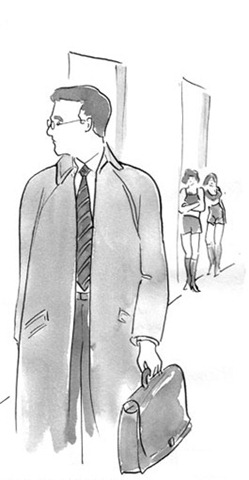
Person #4 has been working late in the office and went out to a local establishment not far from the client’s office. The patrons of this place included men and women and other PROFESSIONAL women. Person #4 decided that since the client’s office was close, convenient and quiet by this time of the evening that he and his two rented companions could make use of the client’s office for their liaison. Now not all rooms were large and had doors, so they selected the client’s main conference room. Person #4 and two of his new friends, who had already started earning their fee, were busy when interrupted by a shocked member of the client’s staff. The client had deactivated his pass card before I was even made aware of the incident.

Person #5 (the winner)

buscard

Some people will try many tricks to increase their chances of finding a date for the evening. One such trick practiced by a consultant on our team was to pose as an executive of our client’s organization and hand out the business card of a client executive to prospective mates. He’s local, has a great job with a great title. Sounds like a match! The after-hours shenanigans of this consultant caught up with him when after a successful evening, one of our client executives received a long and explicit voicemail from (we’ll call her Jane) Jane. Puzzled and concerned, the client executive calls Jane back, explains that he was not the person she was with but the facts she had gleaned clearly pointed to the person being involved with our project. So Jane and the client executive came to the project location for a visit. It took Jane less than 10 minutes to find the imposter, who was then escorted from the building.

So you won’t  see these in Ripley’s Believe it or not, but they all happened. Some were business-hour integrity failures, some were after-hours integrity failures and some are just inexplicable behavior (the diaper den) but in common with each was negative impact on the client and the consultant/client relationship for every team member.

The moral of these stories is this: when you are working on a client’s premise or participating their community your professional conduct needs to be sustained on and even off-site. If you need to let loose for some R&R, take it out of town and leave your business cards ( and the client’s)  back at the office.

Posted in Consulting Excellence | 1 Comment

The Babelfish for the Interviewer

Doc. What are my chances? the patient asks.
doctorPatient
Well I’ve got great news! This operation has a 90% failure rate, and the last 9 patients have died. So it will certainly be successful on you!
The importance of Track Record
For those that are fans of the late Douglas Adams’ Hitchhikers Guide to the Galaxy books, you will know of the Babelfish. http://en.wikipedia.org/wiki/Races_and_species_in_The_Hitchhiker%27s_Guide_to_the_Galaxy#Babel_fish
The current closest function is provided by our friends at Yahoo http://ca.babelfish.yahoo.com/translate_txt
So for a moment, we are shifting gears from being the consultant to being the hiring employer or client. The difference this time is that when the prospective consultant answers an interview question, the Babelfish will translate it to a factual representation of what was said.
Let’s try it…
Interview question No. 1: “Tell me about yourself.”
“I graduated from University in Computer Science and since then, I have been working contracts in software development in progressively more complex projects for the last X years and have taken architecture leadership roles most recently. I specialize in super-agile short-term projects”
Babelfish Translation:
I got my degree from a mail-order house and have been contracting for years in very small gigs as it takes usually 2 or 3 months before my employer figures out that when I run out of “requirements gathering” questions that I can’t actually program anything at all.
Interview question No. 2: “Why did you leave your last job?”
“The company just wasn’t a good fit for my creativity, but I learned that organizations have distinct personalities just like people do. Now I know where I’ll be a better fit.”
Babelfish Translation:
They fired me for being lazy and stupid.
Interview question No. 3: “Where do you see yourself in five years?”
“I want to secure a position with a national firm that concentrates on enterprise software development. Ideally, I would like to work for a young company, such as this one, so I can get in on the ground floor and take advantage of all the opportunities a growing company has to offer.”
Babelfish Translation:
Being a small company, your HR practices won’t be a thorough as a big one. If I can slide through this interview it will be months before you realize your mistake.
Interview question No. 4: “What are your weaknesses?”
“In my last position, I wasn’t able to develop my configuration management skills to the expert level. I’d really like to be able to work in a place that will help me get world-class.”
Babelfish Translation:
Well it was either the standard CM answer or the old stand-by “I worked too hard”.
Interview question No. 5: “Why were you laid off?”
“As I’m sure you’re aware, the economy is down right now and my company felt the effects of it. I was part of a large staff reduction and that’s really all I know. I am confident, however, that it had nothing to do with my job performance, as exemplified by my accomplishments. For example…”
Babelfish Translation:
Because I contributed the least and really wasn’t very good at my job.
Interview question No. 6: “Tell me about the worst boss you ever had.”
“While none of my past bosses were awful, there are some who taught me more than others did. I’ve definitely learned what types of management styles I work with the best.”
Babelfish Translation:
All bosses are equally bad. They think that just because they employ me they have a right to barge into my cube and interrupt my power nap.
Interview question No. 7: “How would others describe you?”
“My former colleagues have said that I’m easy to do work with and that I always hit the ground running with new projects. I have more specific feedback with me, if you’d like to take a look at it.”
Babelfish Translation
They would say I hit the ground running. I hit the ground running at 4:59pm every day. Straight to the pub with my friends.
Interview question No. 8: “What can you offer me that another person can’t?”
“I’m the best person for the job. I know there are other candidates who could fill this position, but my passion for excellence sets me apart from the pack. I am committed to always producing the best results. For example…”
Babelfish Translation
Nothing actually, there are many better qualified, motivated people who can do this job for way less than I am asking.
Interview question No. 9: “If you could choose any company to work for, where would you go?”
“I wouldn’t have applied for this position if I didn’t sincerely want to work with your organization.”
Babelfish Translation
Any place that wouldn’t get so cranky about letting me put a well-stocked beer fridge under my desk.
Interview question No. 10: “Would you be willing to take a salary cut?”
“I’m making $X now. I understand that the salary range for this position is $XX – $XX. Like most people, I would like to improve on my salary, but I’m more interested in the job itself than the money. I would be open to negotiating a lower starting salary but would hope that we can revisit the subject in a few months after I’ve proved myself to you.”
Babelfish Translation
Heck yes, it’s not like you’re going to get any work out of me anyway.
___________________________________________________________________________________
Okay … perhaps that was a little cynical. I guess the point that I am trying to make is that CV’s and interviews while useful are not the best way to determine a candidate consultant’s fit for your project. What is most important and very rarely pursued with rigor is the validation of track record and references. It may not be the end of the world if you make a hiring mistake on a entry-level C# developer, but if you make a mistake on your PM, your architect or a senior technical lead the results can be disastrous.
“Yes, but they were MCSD Certified!”, you say.
Yes the certification tells you that they could know or do something. It does not tell you that they have done it or will.
As a consultant the most important thing you have to sell is your track record. As a hiring client, the most important thing you can do, is to check that track record.
Posted in Consulting Excellence | 1 Comment

Up in the Air with Clooney

Up in the air trailer

“The timely odyssey of Ryan Bingham (George Clooney), a corporate downsizer and consummate modern business traveler who, after years of staying happily airborne, suddenly finds himself ready to make a real connection. Ryan has long been contented with his unencumbered lifestyle lived out across America in airports, hotels and rental cars. He can carry all he needs in one wheel-away case; he’s a pampered, elite member of every travel loyalty program in existence; and he’s close to attaining his lifetime goal of 10 million frequent flier miles—and yet… Ryan has nothing real to hold onto. When he falls for a simpatico fellow traveler (Vera Farmiga), Ryan’s boss (Jason Bateman), inspired by a young, upstart efficiency expert (Anna Kendrick), threatens to permanently call him in from the road. Faced with the prospect, at once terrifying and exhilarating, of being grounded, Ryan begins to contemplate what it might actually mean to have a home.”

I mentioned in my blog The People You Meet – Consulting Lessons from Goldie Hawn that I had travelled a great deal. Many millions of miles actually in my consulting career. In North America, I have seen every major city, most minor and many 1-horse or perhaps better said 1-company towns. Ask any IT vendor in Canada where Florenceville, NB is and they can surely point the way. (McCain’s by the way) I have travelled all of Central America, most of South America, every country in Europe, all the populace ones in Asia and similarly populated South Pacific countries. I have only missed the entire continent of Africa and most of the middle east, but I suspect that before I am done I will include many stops from there also if not from work, then from some charity work I have been engaged with for many years.

When I was watching the Clooney movie recently, (yes it was on an Air Canada flight), I was approached by the Flight Service Manager who in apology for not being to grant an upgrade (Olympics) offered a first class meal and drinks for my convenience. The irony of that occurring while watching Clooney on the LCD pushing to attain his 10 million airmile mark was not lost on me.

So any consulting excellence blog needs to also talk about you. Your ability to stay sane with remote project work and to reap some of the benefits from your hard work and if you have a family, how to keep them intact.

So you will get some things in this blog that are deeply personal and a reflection of the harsh lessons that I have learned.

#1 – Quality Time

The notion of quality time with your family is absolute nonsense. You family does not need the trip to Hawaii first class on air miles points more than they need you there for the little league game, the music recital and the untimely death of the “franny” the goldfish.  The concept of quality time is a hoax. Quantity matters. When you accept a consulting role, do the math.  Some engagements will use words like: “Some travel required”. I’ve done “some travel”. I’ve travelled over birthdays, holidays, Christmas, new years, funerals, recitals, championship games, parent-teacher conferences and the like.  I can assure you that “some travel” must be better defined and carefully assessed. If I were to give you unsolicited advice (hey you’re reading my blog) here are the guidelines I would suggest.

  • projects over 1 year – Move – Don’t fly – Take the people you care about with you. If you have kids and the kids are little, they are much more adaptable than you think….
  • do NOT miss birthdays, holidays, Christmas, New Years, funerals, recitals, championship games and parent-teacher conferences. They are more important than you think….
  • establish a minimum amount of time that you will spend each month with everyone who is important to you, and plan work around that. If your job doesn’t allow it. Get a different job. I can guarantee you will regret it if you don’t.

#2 – Your alternate you

Now that sounds silly, but stay with me for a moment. In the movie “Up in the Air”, Clooney was special. His character Bingham I can identify with (although I think I’m better looking (:>) ), because everyone does know your name. You are treated with kid gloves, as “special” and for a while in my career I bounced around in a Gulfstream business jet,

7Interior

that took off when I wanted and when it landed there was either a limo or a helicopter waiting to take me to my final destination…. and then you go home and the grass needs cut and your platinum card does not get you out of doing the dishes.  The alternate you. I must admit that I completely blew this one. I am giving advice not out of my success but out of my failure to keep a single version of myself. I definitely created two very different personae. The Corporate Executive/World traveller persona with a multi-Billion dollar project portfolio and the “Dad, the dog barfed on the floor again”  persona. The only advice I can give here is to make sure there is just one version. Either bring the exec home to the family or take the “dog barfed” attitude on the road, but don’t make two versions. If you do, someday you will wake up and find the people you care about don’t know who you are anymore.


wallpaper_02_1024x768

Posted in Consulting Excellence | 1 Comment

What’s going on in the new client’s head?

Your client has lots of things to think about. They have likely had both good and bad experiences with consultants, and you are new, an unknown entity. Some of the questions that may not be verbalized but are likely rolling around in your client’s mind include:

  • Will this consultant show me up?
  • Will this consultant be acceptable to other people in my organization?
  • Is the consultant working to understand my situation or just billing?
  • Will the consultant keep to my pace?
  • Will this consultant push me too hard too quickly?
  • What will this consultant deliver?
  • If I speak openly, will this consultant respect what I say?
  • How confidential is this conversation?
  • Will I be able to control this consultant?
  • Will my boss ask why I am not doing this project?
  • Will this consultant say no to anything I ask him or her to do?
  • What will I do when this consultant is gone?
  • How much of a threat is there to me by working with this consultant?
  • Will the proposed solution be practical?
  • What is this going to cost?
  • How long is all of this going to take?
  • How good are this consultant’s technical skills?
  • How much money can we save?
  • What is in this for me?

and that’s just in the first 5 minutes….

I have hired hundreds of consultants for projects I have led.  Even being in the business, you still ask the same types of questions.  You have done a review of the résumé, had an initial phone call, perhaps a face to face meeting, checked some references and here they are… day 1. The client/consultant relationship starts.

Let me give you some real life examples of what not to do on your first few days.

You have been hired onto a very large, very long term project in a mid-western US city. You are provided with a client-provided corporate apartment as part of the package. You fly into the city, rent a car and go to the corporate apartment. Arrangements have been made to leave you a set of apartment keys with the landlord, but something has not been communicated and the keys are not available. You do which of the following actions:

  1. drive to local hotel and check-in for the night and get the problem addressed tomorrow
  2. find another project team member and borrow a sofa for the night.
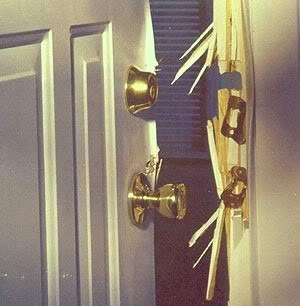
  3. kick the door to the apartment in and say “well where else was I going to sleep?”

Yes Action (3) is the incorrect one and yes done by a consultant I had hired. It was the first time that I actually fired someone before they showed up for the first day at work.

door_broken

You have joined a project team and it will grow from 20 people to over 500. The project is changing locations to another much larger building. You are moving in as renovations on the building are taking place to accommodate the larger team.  As it is mid-renovation the washroom facilities are not yet renovated and are in disrepair.  You do which of the following actions:

  1. Use the facilities in the 4 star Hotel next door. (60 seconds away)
  2. Bring it to the attention of your consultant team lead to see if the work can be prioritized
  3. Call the local health department officials yourself to get them to inspect it and force closure of the office until renovations are complete 4 weeks later.

Yes Action (3) is the incorrect one and yes done by a consultant I had hired.

Washroom

So yes, your client may be thinking of all sorts of things. Experiences both good and bad that they have had with consultants. Your job day 1 is to put them at ease, and convince them that their worst fears will not be realized. How do you do that?

The answer is not in what you are going to do but how you are going to do it. It’s the how they care about the most, the what they will assume you can do.

Hi Cheryl

Can we talk for a few minutes about how I work and how best we can work together on this. I want to make sure that I meet your expectations and work with you in a manner that you enjoy. First of all let me say that as my client, my responsibility is to you. I will never communicate anything above you in the organization without your express permission. We are currently estimating that phase 1 will take 8 weeks, but I would like your feedback on frequency and the agenda of the checkpoints as we move along. That way we can be assured that you and I are always 100% in-sync. ….. etc.

Posted in Consulting Excellence | 1 Comment

Mastering the Art of Influence

If you have not read my blog on Ambidextrous Influence , it is a pre-req for this blog. Sound like 4th year university? Yeah, but you really need to read it first.

Why because this is the master’s level course.

Like everything else influence is a process. The key to success is this…

Hi Bill, Now we took a look at your Lotus Notes Environment. Before we tell you about our vision for Business Productivity tools, let’s give you a magic wand. This wand could fix anything in your current environment. Here, take it. What would it fix? … So now let me walk you through your CEO’s new experience. When she comes into her  office in the morning here’s what she will see …

Now you know that the application migration will be $1 Million. If you can authorize the capex on that, I can deliver the new system ready-for-use by  September….I know you have a board meeting on the 15th. I can have a world-class presentation ready for you so that the benefits of this decision will be obvious to each member. We can even have the board portal ready for them at that meeting, if we move quickly with Phase 1….

“Ian, I don’t know if I can get that size of a Capex approved that quickly”

Bill. Let’s take a look. If you were at the board meeting right now, would you tell them about the productivity increase? … Would you tell them about the travel savings? … We worked on that ROI ourselves, it’s solid. Let’s put your project on the cover of CIO magazine. What would that say about your company and the willingness to embrace the future? ….

“I am still worried about getting a million right now..”

Bill. What are the implications of doing nothing? … You will still write a check for $2M to IBM for licenses for a product everyone hates. .. Here is this list of things you wanted to fix… Are you prepared to tell the board that a do-nothing strategy is the best idea? What are the implications for the company? What are the implications for you?

Imagine standing in front of the board of directors and being the first person for a decade to show how IT can really fuel innovation and revenue for this company…..

Now let’s play this back with analysis…

Hi Bill, Now we took a look at your Lotus Notes Environment. Before we tell you about our vision for Business Productivity tools, let’s give you a magic wand. This wand could fix anything in your current environment. Here, take it. What would it fix? … (pull visioning) So now let me walk you through your CEO’s new experience. When she comes into her  office in the morning here’s what she will see … (pull visioning)

Now you know that the application migration will be $1 Million. If you can authorize the capex on that, I can deliver the new system ready-for-use by  September (push – bridging)….I know you have a board meeting on the 15th. I can have a world-class presentation ready for you so that the benefits of this decision will be obvious to each member. We can even have the board portal ready for them at that meeting, (push – bridging)….if we move quickly with Phase 1…. You should also gave have chat with Audit and the CFO. there are SOX compliance issues you can resolve… (push – standards)

“Ian, I don’t know if I can get that size of a Capex approved that quickly”  (client resistance – switch modes)

Bill. Let’s take a look. If you were at the board meeting right now, (pull –environmental management )would you tell them about the productivity increase? … Would you tell them about the travel savings? … We worked on that ROI ourselves, it’s solid. (push – assertion) Let’s put your project on the cover of CIO magazine. (pull visioning) What would that say about your company and the willingness to embrace the future? ….

“I am still worried about getting a million right now..”

Bill. What are the implications of doing nothing? … You will still write a check for $2M to IBM for licenses for a product everyone hates. .. (push – assertion) Here is this list of things you wanted to fix… Are you prepared to tell the board that a do-nothing strategy is the best idea? What are the implications for the company? What are the implications for you? (push – assertion)

Imagine standing in front of the board of directors and being the first person for a decade to show how IT can really fuel innovation and revenue for this company…..(pull visioning)

etc.


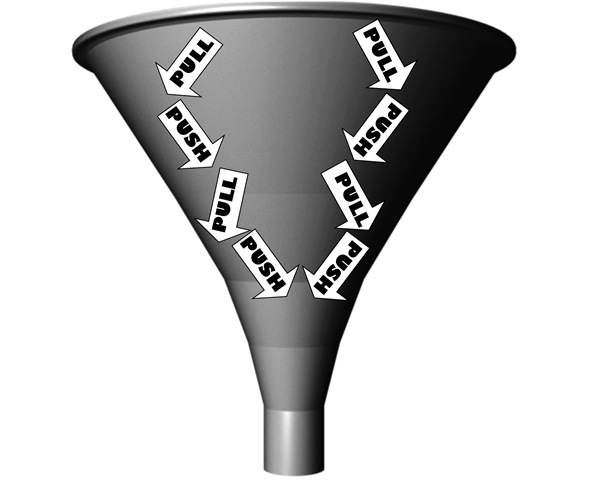
funnel_pull_push


Pull styles – open things up and help to draw the client out , see possibilities and motivate

Push styles – inform and assert and close down the options.

The art of influencing is achieved by balancing push and pull styles every interaction with a client such that in each sequence the client moves closer to the decision point.

Balance

What happens if you use push style too much?

You will alienate your client.

What happens if you don’t use push style at all?

You will never be effective at influence.

The art is learning when to pull and when to push and how to construct it so that in each cycle you get closer to the goal. Be Patient…. Give it time to work.

** Warning: The above technique if ever applied during a relationship such as partner, spouse, sig. other etc. is at your own peril and is recommended for consultant/client interactions only.

Posted in Consulting Excellence | 3 Comments