Ambidextrous Influence


Stanton-fire2-4c-color

“Hey guys come here a minute. I’d like to get your input on what you think the best approach is here. Jack thinks the best practice is an aerial approach, Jim is advocating for the “old school” water-in-the-window and the rest of you really haven’t weighed in yet. I’ve asked the neighbor if we can borrow their kitchen table for a while for a little bit of a team session on this one.” states Fire Chief Dan.

Dan has recently read a number of leading business publications that talk about the importance of fostering a good teamwork environment and the importance of team-based decisions. He wants the best for his department. His client Mrs. Ford, the homeowner, however is not fully “bought-in” to the team-based decision approach. She just wants the fire out.

When I ask any group of consultants how they make or influence decisions with a client group they invariably  provide a “Fire Chief Dan” type of answer; consensus, team-based, equal vote, team “buy-in” etc.  While I agree that team based decisions are the best for team commitment to execution there are at times a critical requirement for different styles. The best consultants learn how to correctly identify those situations and then apply the correct style.

You don’t think there are house fires in IT? Think again. Let’s have your client’s national retail electronic payment system go down on December 24th. Does your client want a team conference?

Let’s talk about influencing styles.  There are “Push” and “Pull” styles.

push_me_pull_you

Push styles

Style

Force

Rules and Standards

Exchange

Persuasion

Assertion

Example

Do this now or else.

Sarbane-Oxley requires compliance to the following.

If you do this then I can do that

If you do this based on your trust and experience with me. I have not let you down before.

By doing the following, the following will result

Sample usage

Engineer with down mission-critical system

Governance consultant

Architectural Design Trade-off

Long Term Strategy engagement direct with Sponsor client

ROI, TCO reduction, ROA

Type of Client Situation

Emergency

Government, Large Institution

Technical

1:1 or trusted team

Analytical client, CFO

When to Use

911

Policy centric, bureaucratic environments

Technical and business trade-offs example: high availability versus cost savings

When you know the direction is correct and you are willing to put your credibility on the line or know the client will be tolerant of a failure.

In process, loose relationship with client, early relationship with client, risk averse client (personally)

Impact

Short Term compliance Long Term damage

Safe and slow progress with minimal risk to client’s personally.

Quick, concise

All parties may not be pleased

Quick. Clearly leaves liability with the persuader.

Moderately quick. Factual

Good buy-in

When Not to Use

Non-urgent situations or culturally prohibitive

Time sensitive results required.

When exchange is perceived as win/loss.

Uncertainty of the direction

Expectations that you alone are to provide guidance


Pull Styles

Style

Personal Magnetism

Visioning

Bridging

Environmental Management

Joint Solutioning

Example

This is why I get up in the morning. To tell people about X.

I love X.

Can you imagine? Walk with me into the future call centre.

Now if we add this then the sales group can receive the following benefit earlier..

We have asked Jane and Bob from Corporate records to join us today to talk about the impact on compliance if we do or do not implement the records management feature.

Now we are looking for a roundtable discussion on this Use Case. Every feature request is valid at this point and no idea is stupid.

Sample Usage

Steve Ballmer

Initial concept development

Initial architecture development etc.

Feature scoping, deliverable planning

Group meetings

Steering committee

Group meetings

Type of Client Situation

CIO roundtable

Large Conference etc.

Envisioning

Planning

Pre-Sales

Giving each stakeholder a portion of what they want. Trying to create synergy or where necessary. make compromise less painful.

In-process decisions affecting broad range of stakeholders.

Different knowledge levels in participants.

Joint requirements gathering sessions.

When to Use

Peer or world-class notable.

Early in the process. Best Opportunity to validate and define scope by providing a bigger vision.

Mid-process where group decisions and trade-offs must be made.

Mid-process where group decisions and trade-offs must be made.

Committee may have incomplete knowledge.

As often as you can.

Impact

Initial kick to start looking at an area.

Expands horizon, validates entry and diagnosis steps by providing big picture context.

Creates uniformity and encourages teamwork.

Can bring all members up to speed without singling out any member.

Highest Team buy-in, participation and commitment.

When Not to use

Non-peer, 1:1

In development.

1:1

1:1

Ultra-dominant client.

1:1

Ultra-dominant client.


  • Pull styles help to draw the client out and to talk about their concerns and motivations.
  • Push styles inform or impose on the client and are most useful when the client is uncertain.
  • If you feel resistance from the client, switch to pull.

Top Tip

In every interaction with a client seek to achieve a balance between push and pull.

Don’t fool yourself. No matter the role you have been asked to do, you are consulting and by definition, the client has asked and is paying for your

professional influence on their project.

Posted in Consulting Excellence | 3 Comments

Going the extra mile for your client

Sorry for the lack of metric measures but going the extra mile for your client is better than a kilometer. There are about 2000 steps in a mile and about 1320 steps in a kilometer and those extra 680 steps could really mean something important.

extra_mile

I asked a dozen or so of my colleagues the following question “what is the most unusual thing you have done for a client outside the bounds of the engagement?”

Here are some of the answers:

1) Bought hard-to-get tickets for them for a concert at one of the destinations they were at

2) Brought the client a box of Live Atlantic Lobster

3) Brought the client Real Canadian Maple Syrup

4) Brought the client frozen “moose” burgers

5) Brought the client to my cottage when they were visiting on vacation

6) Played Santa Claus for their kids Christmas party

7) Brought the client fresh Pacific Salmon

8) Dropped a birthday package off for the client  for a relative in my home city.

9) Cooked dinner for them

10) Took them to Niagara Falls

11) Watched their dog for a weekend.

12) Went with the client on a Habitat-for-Humanity build

13) Took a 5 minute movie of a polar bear for the client’s child’s science project

14) Brought the client some Southern Pecans.

Do you notice any commonality in the list? They are all things that you would do for or with a friend. They are not things that you would be compelled to do and they are all pretty easy to do and likely enjoyable.   I asked two follow-on questions to each person who responded.

  • Would you do it again?
  • How would you describe your relationship with that client today?

Uniformly the answers were: a) of course I would do it again and b) all of the clients were either still great clients and/or long term friends. On long term projects where you are able to fully develop a team, you will also develop some friendships. There is no rule that says you cannot be a professional consultant, a trusted advisor and a trusted friend at the same time. While friendship with a client increases the possibility of a conflict of interest, it does not need to increase the probability of it. I think that the strongest client relationships make for the best decision-making and productive environments. You can remain detached and clinical with your clients but I believe the benefits outweigh the risks for taking those extra 2000 steps.

Santa Ian 4 December 13

Posted in Consulting Excellence | 1 Comment

Finding, Understanding and Communicating Your Value


Imagine. You are on the road somewhere and you have been in meetings with the CTO of your client all day. You are tired and go  back to your hotel room and fall asleep. At 4 am in the morning you hear “knock, knock, knock” on the door , you get up and open the door. At the door is the client company CEO.

They say to you, “ I hear you are engaged at my company. You have 60 seconds to explain your value to my company or you are fired.”

image

The clock starts now.

I do this as an exercise with consulting teams in my Advanced Consulting Skills Course.  I give them 60 seconds to craft a response indicating their value and… most people fail miserably the first time they attempt it. The reason for this is that most of us do not think about communicating our value. We may know that we are good at our job, but not certain how to express that and even less certain how to express that to a client. Here is the awful truth. Sorry folks.

If you cannot express your value and differentiate yourself from the crowd, you are by definition a commodity. The same as every other consultant. Commodity consultants (and there are lots) get the worst engagements and get the least compensation.

Top Tip – A consultant being able to express his/her value is the most fundamental of consulting skills and it is one of the most difficult items to get them to do well. Your success in this endeavor will make the difference between having the opportunity to be an excellent consultant or not. Don’t treat it lightly …..

The population of consultants easily divides into two distinct groups: the ordinary and the excellent.

Ordinary consultants can be spotted by these tell-tale signs:

  • “I like clients who know what they want”
  • “I like helping my clients out”
  • “I am happy to do most things that are asked of me”
  • “I like to be invited to help”
  • “I am not sure I have the right to question?”

The attitude of these ordinary consultants will result in:

  • Being used as a pair of hands, brought in as needed
  • Superficial involvement
  • Ineffective use of time
  • Incomplete projects and projects of marginal value
  • Value unclear and being questioned
  • Low influence with client

Excellent consultants are rare and more in demand from clients. They can be overheard saying:

  • “I specialize in these three areas”
  • “I work with my clients to solve this type of problem”
  • “I always deliver”
  • “I always ask the question: ‘How will this add value?’”
  • “I offer my views in these areas based on my expertise”
  • “I pleasantly surprise my clients with what I do and say”

The approach of the excellent consultant results in:

  • Partnership with clients based on shared objectives and plans
  • Requests for advice
  • More rewarding and challenging work
  • Development of reputation and expertise
  • A powerful, confident attitude from consultant
  • Value added clear for all to see

You want to be excellent. What do you need to do? Among other things, you need long-term commitment, focus and depth of expertise. You also need a crispness and confidence when you handle yourself in front of the client. Your first step is to answer credibly the client’s first question: “What can you do to help us?”

Many ordinary consultants fall at this first hurdle. They have not done the essential preparation for operating as a consultant. They do not really know the value they add. They cannot always answer the question: “Why did the client come to us?”.  To be clear about the value you add entails trying to see yourself as others see you. This is not easy but it is important to do. Once the value you add is clear in your own mind, the more effectively you will be able to communicate that value to your clients.

Think about the differentiators…..

What makes you more valuable the other consultant with similar qualifications on their resumé?

  1. Better aligned experience
  2. More specific skill set
  3. Better processes for how you work with your client
  4. Better track record
  5. Better productivity
  6. Better mentor to the client resources
  7. Easier to communicate with
  8. Easier to work with
  9. Better results
  10. More professional
  11. Clearer or more thorough documentation
  12. Pragmatic or experiential approach
  13. Quality
  14. Productivity
  15. Domain expertise
  16. Intellectual property
  17. Organizational depth & other backup resources
  18. Communication abilities
  19. Analytical and design capabilities
  20. Teamwork capabilities
  21. Availability
  22. Consistency
  23. Durability
  24. Flexibility
  25. Familiarity with client tools and processes
  26. Multi-Lingual
  27. Multi-process
  28. Process adaptability
  29. Strong Client References
  30. Strong Team References

Only you know the answer.  Take some time and make your own list of 30 items. Feel free to borrow and expand on the ones above, but only pick the ones you personally truly believe in.  When a client asks you to explain it, you can.

The next step is to now think like your client or at least a prototypical client.  Which ones of the list of 30 are they interested in for their next project?

Now craft a very short, very succinct paragraph for the top of your resumé. Why? Because your future client does not want read about your career goals and the fact that you own a cat. They want to know how you are going to help them solve the specific business challenge they are hiring for. A resumé is a terrible vehicle to accomplish that, but let’s at least take the first paragraph to see if we can make an impact.

In one paragraph answer these 3 things, they do not have to be in any order.

1. Problems my clients face – When you want to….. but………..

2.  Services you can offer – I can ……..

3. Benefits of your involvement – My clients say the benefits they gain from my involvement are ……

Now go back and add the differentiators from your list.

Here is just 1 of my versions.

With over 25 years experience in complex solution engineering and mission critical program management I have successfully designed and implemented solutions for my clients that include;

  • Enterprise Financial and Government Business Solutions
  • On-Line Distributed Transaction Processing
  • Executive Information Systems & Decision Support Systems
  • Complex Network Integration
  • Complex Multi-Vendor Systems Integration

The combination of my project leadership and technical expertise, advanced methodologies and tools combine together to reduce risk, ensure quality and minimize the time to realize the benefits of my clients’ information system solutions.

For the last 11 years, I have been architecting optimal solutions exclusively on the Microsoft platform. My work with enterprise clients spans from the inception of business strategy and concept, to estimate and business value assessments, technical and application architecture, through to full project execution and resultant benefits management.


So in 1 paragraph I have picked up items from the list of differentiators that are appropriate for my enterprise client looking for a Microsoft-technology architect to lead a large new mission critical solution initiative. I would change this on a client by client, project by project basis to have the most impact for that client.  You will see another version of this on my linkedin page.

It’s not easy. Imagine sitting at your prospective client’s desk. They have a stack of resumés, what are they looking for? what are they most worried about? what is the specific skill or differentiator that you have that could help them?

Now for $100 you can submit your resumé to a CV Polishing service and they can send it back with all the nice words and make it look professional. They cannot however write that first paragraph. That must come from you. You must believe it and every word of it must be fully accurate.

Write it and then do the hotel room test. Knock, knock , knock…. You have 60 seconds to explain your value or you are fired……..

Keep trying it until you can answer it quickly and honestly every time.

PS. When you tell the truth, it is not bragging. It is just communicating your true value. If you don’t communicate your differentiating value, you are a commodity.

Posted in Consulting Excellence | 3 Comments

Just because you are necessary, does that make you valuable?

value

Well let’s check the definition:

1 : a fair return or equivalent in services, or money for something exchanged
2 : the monetary worth of something
3 : relative worth, utility, or importance <a good value at the price>
4 : something (as a principle or quality) intrinsically valuable or desirable

Until we got to #4 on the list, anybody in that spot performing the required set of tasks would do. But #4 changes the answer.

No just because you are necessary does not implicitly make you valuable. If you can be replaced by another less costly cog then by definition the client receives better value. So as consultants where does our value come from?

image

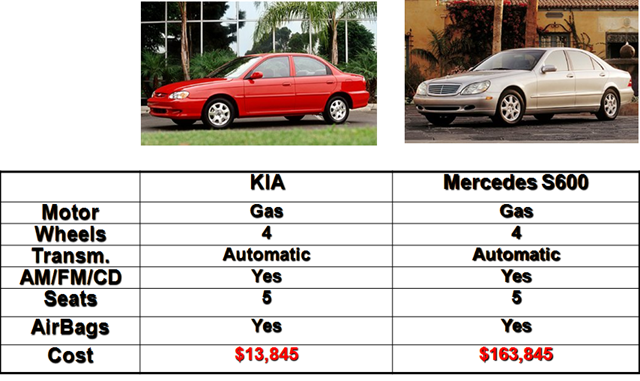
So the example above compares 2 cars. Same fuels, same # of wheels, both can get your favorite FM station, they both seat 5 people and they both have air bags for safety. One car is $13,845 off the lot, the other exactly $150,000 more.  If you just needed transportation, then clearly the KIA is better value than the Mercedes. But its not the only criteria by which people look at value.

image

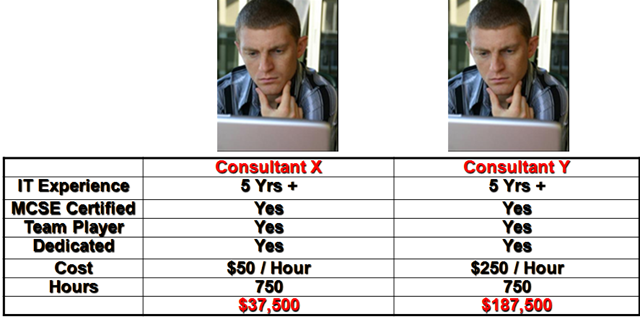
In order to not be evaluated as the lowest cost commodity, we as consultants need to ensure that all of the attributes that are valuable to our clients are on the table and what I mean by that is VISIBLE.  In the above chart what’s missing?

  • quality
  • productivity
  • domain expertise
  • track record
  • intellectual property
  • organizational depth & other backup resources
  • communication abilities
  • analytical and design capabilities
  • teamwork capabilities
  • availability
  • consistency
  • durability
  • flexibility
  • familiarity with client tools and processes
  • etc.

So if you want to be a commodity consultant and sell your services as cheaply as possible, you do not need to read my next blog.  My next blog will be focused on exactly the opposite. The topic will be how to both understand and communicate your true value to your client. If you don’t want to read that, you may instead wish to click on the picture below to assist you with your next career step.

fries

Posted in Consulting Excellence | 4 Comments

A double cheese burger, extra large fries, and a small diet Coke.

A while ago, I ran out for lunch with a new client. Nothing special just a local diner. I ordered a club sandwich and he ordered a double cheeseburger, extra large fries and a small diet coke.  There are about 450 calories in a double cheeseburger, 540 calories in an extra large fries and either 97 or 1 calorie for a small regular or diet coke respectively.  The lunch choices are therefore:

– 1087 Calories (with regular Coke)

– 991 Calories (with diet Coke)

Both meals are the cholesterol/caloric  equivalent of  a Scotch Egg, perhaps the world’s most unhealthy meal and a Scottish tradition. (An egg , wrapped in sausage meat, breaded and deep fried) http://en.wikipedia.org/wiki/Scotch_egg 

So I was perhaps a little curious with the drink selection and tried to be tactful by stating; “ I always like the taste of Diet Coke better myself too..”. “Not me” was his reply, “I like regular coke but I have to keep breakfast and lunch meals together under 1,000 calories and I skipped breakfast today”.

The choice of the Diet Coke was an explicit decision, that had involved research, analysis and the application of rules. If I hadn’t investigated a bit, I would have just shook my head, laughed a bit and would not have found something about my client that turned out to be very important. He always, always made decisions based on analysis and rules.

Consulting is a process with lots of steps. When we miss steps, there is inherent danger in completing the engagement safely.  Even when the steps seem to be too simple to do, if we do them anyway two things can happen:

  • we might learn something we did not know and perhaps assumed differently
  • we can continuously improve the process, but only have that opportunity if we actually do the steps.

missing_steps_bridge

Most IT consultants incorrectly engage when the problem has been defined, the solution has been offered and what is required is execution. It misses two very critical steps at the beginning of the process.

consultancy_process

The Entry Stage

The aim of the Entry Stage is to develop and agree to a stable, balanced and workable set of arrangements with the client. These arrangements provide the basis for an effective working relationship throughout the consultancy project. You have clarity about how you are going to work together and the process to get to the end. You use this stage to develop rapport with your client, find out what their concerns are and learn a little bit about how they work.  (you can find out a lot about a person from a Diet Coke)

The Diagnosis Stage

The aim of the Diagnosis Stage is to identify the real problem. In other words, the source of your client’s problems not just some of the effects of the real problem. Most importantly to make sure your client has not incorrectly identified the problem.

An example perhaps.

A consulting company (the other guys) was engaged to implement a high availability solution for a customer as sporadic outages were occurring. The HA system was implemented and outages continued to occur on both primary and fail-over environments. Actual cause: Sporadic testing of DR generators altered power supply to the SAN serving this cluster, causing disk timeouts and application failures. The main servers were plugged into an advanced UPS which cleaned the power supply, the SAN was errantly not and was subject to sporadic failures during the tests. Question: Was the client happy with their new $1 million HA infrastructure and “the other guys”…. No. not at all.

So before you start on the next consulting engagement, add two steps. Spend some time with your client mapping out the process, get to know how they work and bit about them.  Then diagnose or re-diagnose the problem or task. Make certain you are fixing the right thing.

Neither of these steps need to take very long. They just need to be done to strive for excellence.

dietcoke

Posted in Consulting Excellence | 2 Comments

When E.F. Hutton Talks, People Listen

You may or may not not be old enough to recognize the phrase in the title but E. F. Hutton & Co. was a brokerage firm founded by Edward Francis Hutton. Hutton became one of the most respected financial firms in the United States and was best known for its TV commercials in the 1980s based on the phrase, "When E. F. Hutton talks, people listen" . The commercial would usually have a large noisy crowd somewhere and when one person said “well my broker is EF Hutton and they said…” and the room falls silent to listen in.

80’s EF Hutton Commercial

There are two such people in IT today that should garner the same response from a crowd of IT people.

Don Box – The creator of SOAP and a Microsoft Distinguished Engineer (ie. a really, really, really smart guy who has done amazing things) http://www.microsoft.com/presspass/exec/de/Box/default.mspx

Jack Greenfield – Former Chief Architect of Rational XDE and now Chief Architect Enterprise Frameworks and tools with Microsoft. (ie. a really, really, really smart guy who has done amazing things) http://msdn.microsoft.com/en-us/library/aa480032.aspx

When they talk and they are talking, the IT world really should just be still for a moment and listen intently. They are saying things that will change the software development world. Okay, let me make it more personal. They are talking about whether you will have an income in the next few years and be able to pay your mortgage or not depending on whether you listened and did something about it or  you will be learning the phrase “and would you like fries with that?”

Take a few minutes to listen to Don Box about Oslo and “M”

http://channel9.msdn.com/posts/Charles/Don-Box-Paul-Vick-and-Chris-Anderson-Introducing-M/

Don’t let the low-key approach fool you. This is a game-changer.

  • SQL Server Modeling Services (formerly the ‘repository’), a core database role for models and a set of shared, common domain models. Modeling Services is built on Microsoft SQL Server) and is highly optimized to provide your data schemas and instances with system-provided best SQL Server practices for scalability, availability, security, versioning, change tracking, and localization. Common domain models include identity, CLR, and UML.
    • This means the hard stuff is already done for you…
  • A configurable visual tool (Microsoft code name "Quadrant") that enables you and your customers to interact with the data schemas and instances in exactly the way that is clearest to you and to them. That is, instead of having to look at data in terms of tables and rows, "Quadrant" allows every user to configure its views to naturally reveal the full richness of the higher-level relationships within that data.
    • This means highly interactive, easy to understand, less errors and fast ….
  • A language (Microsoft code name "M") with features that enable you to model (or describe) your data structures, data instances, and data environment (such as storage, security, and versioning) in an interoperable way. It also offers simple yet powerful services to create new languages or transformations that are even more specific to the critical needs of your domain. This allows .NET Framework runtimes and applications to execute more of the described intent of the developer or architect while removing much of the coding and recoding necessary to enable it. "M" does not mandate how data is stored or accessed, nor does it mandate a specific implementation technology. Rather, "M" is designed to allow users to write down what they want from their data without having to specify how those requirements are met by a specific technology or platform.
    • How much faster can you deliver when the “how” is taken out of the equation?

Now hear what Jack Greenfield is saying about the Software factory approach and domain specific languages.

“Hi, my name is Jack Greenfield. I’ve spent most of my career building either enterprise applications or model-driven frameworks and tools for enterprise application developers. I am currently an architect with Enterprise Frameworks and Tools at Microsoft. Before coming here, I was the chief architect for Rational XDE. …In my mind, the primary factor that will determine the success or failure of model-driven development in the industry today is pragmatism. There is a stark contrast in terms of pragmatism between the two leading approaches, which are software factories from Microsoft and MDA from IBM and the OMG. With MDA, you have two domains, or viewpoints as we call them, the platform-independent model and the platform-specific model. These two viewpoints are both based on UML which is a general-purpose modeling language, and they are related by transformation, since PSMs are generated from PIMs. With software factories, by contrast, you have an arbitrary number of viewpoints such as user interaction, business work-flow, or logical database design to name a few. In fact, you can define as many viewpoints as necessary to describe the business requirements in the software under development. Each viewpoint is potentially based on a DSL but is tailor-made to address a set of unique concerns for that viewpoint. Viewpoints can be related by nesting and by a variety of operations such as trace, validation, analysis, refactoring, weaving, or optimization in addition to transformation…So we learn more about key abstractions in the domain by working with these less automated forms of guidance; we can gradually move to models. So what is different this time from the CASE tools in the 1980’s? I think it is precisely the pragmatic bottom-up approach we are taking with software factories. Unlike MDA, which optimistically assumes like CASE did that most or all of the software can be generated from models, software factories blend modeling with other software development practices to meet the needs of developers in the real world.”

So what do you get when you take a technology that allows you to work quickly with your user to express a domain in any manner that makes senses to them, automate all of the data work so you only have to describe what you want done , not how and then combine this with a software factory approach to build the solution at light-speed?

If you really pay attention, you will hear that EF Hutton is talking again.

Posted in Technology | Leave a comment

A user will tell you anything you ask, but nothing more.

“I know that you believe that you understand what you think I said, but I am not sure you realize that what you heard is not what I meant.” says a user after reading a Use case “representing” his requirements.

The fine art of knowledge elicitation.  Despite massive advances in technology, the ability to develop applications at light-speed, an original challenge remains from the day the first piece of code was written to today. It’s getting the user to tell you the requirements they want. Actually no,  here’s a news flash. They don’t know their real requirements most of the time. The times they do, they are incapable of expressing it to you in a form that ensures that both of you understand it correctly.

That’s why today’s requirements gathering is a foolhardy exercise. What we really need is much more refined. Knowledge Elicitation.

Try this quick exercise.

Read the following story and then indicate for the 10 statements in the grid if they are true, false or you are uncertain.

“A business man had just turned off the lights in the shop when a man appeared and demanded money. The owner opened a cash register. The contents of the cash register were scooped up and then man sped away. A member of the police force was promptly notified.”


T

F

U

1) A man appeared after the owner had turned off his store lights.


2) The robber was a man


3) The man did not demand money.


4) The man who opened the cash register was the owner.


5) The store owner scooped up the contents of the cash register and ran away.


6) After the man, who demanded the money, scooped up the cash register he ran away.


7) While the cash register contained money the story does not say how much.


8) The robber demanded money of the owner.


9) The story concerned a series of events in which only three people are referred to: the owner of the store, a man who demanded money and a member of the police force.


10) The following events are included in the story: someone demanded money, a cash register was opened, its contents were scooped up, and a man dashed out of the store.


Totals


Now count the number of “TRUE”, “FALSE” and “Uncertain” answers.  Without telling anyone your count, have a friend, colleague or co-worker repeat exactly the same exercise.  Your counts will NOT agree.

If you tried this exercise with a dozen people, the odds that any 2 people would have the identical answers are not good. (great answer from a guy from a University of Waterloo Math program eh?)

However my point is this. The story above has logical gaps in it. The human mind is an amazing thing. It doesn’t like logical gaps and simply fills in the gaps with things it thinks is reasonable. The result is based on context and what the reader thinks is reasonable. Each person interprets the story very differently.

Hence why “requirements gathering” with the usual techniques is pretty much futile.

Knowledge Elicitation on the other hand can be quite useful. http://mentalmodels.mitre.org/cog_eng/ce_references_I.htm#knowledge_elicitation

Definition:

Knowledge elicitation is the formal process of capturing and codifying knowledge required to perform tasks with rules.

It is not “Tell me what you want it to do”

Some Techniques

Interview

Structured

Unstructured

Semi-Structured

Case Study

Critical Incident Method

Forward Scenario Simulation

Critical Decision Method

Protocols

Protocol Analysis

Critiquing

Critiquing

Role Playing

Role Playing

Simulation

Simulation


Prototyping

Rapid Prototyping

Storyboarding

Teachback

Teachback

Observation

Observation

Goal Related

Goal Decomposition

Dividing the Domain

List Related

Decision Analysis

Construct Elicitation

Repertory Grid

Multi-dimensional Scaling

Sorting

Card Sorting

Laddering

Laddered Grid

Document Analysis

Document Analysis


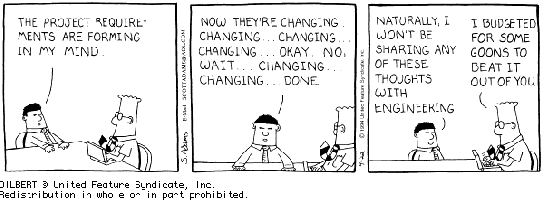
In short, show me, teach me, prove to me how it works and then I’ll prototype it, show you, observe you and then we’ll get someone else to use it and then make sure it meets the goals. So the next time someone hands you a use case, think about the “crime” story above. What are the odds that the user correctly specified all of the pre- and post- conditions for each of the scenarios. … zero% I would say.  As a profession we need to raise the bar on “requirements gathering”. Let’s think about applying more rigor and check points to requirements. It’s not the documents that are bad (Use Cases etc.), it is the processes by which we create them and their ilk that need more checks and balances. The biggest error we make is assuming the user is telling us correctly what they need. Usually they are telling us what they think they need. It may often be different.

dilbert-changing-requirements

Posted in Consulting Excellence | 3 Comments

The Looming Crash of Off-Shore Development

Prior to making any other comment I would like to say that I have worked extensively with excellent off-shore development organizations and without exception they are uniformly excellent with extremely high skill sets and quality development work. So unlike other similar prognostications, mine has nothing whatsoever to do with skill, quality, time-zones or complexity of  management processes. I believe these have all been completely mastered in off-shore development.

The reason that off-shore development is popular is cost.  A very high quality product can be delivered at a lower cost. The problems that off-shore development organizations will face in the next 5 years are two-fold.

  • The cost of doing business; paying employees, finding appropriate offices, powering datacenters is rising fast.  I good friend of mine runs a small off-shore development company. His payroll costs have gone up 50% in two years, his office costs have gone up 100% and his off-shore billable rates have to go up to make it profitable. The IT market is so hot, he must provide project completion bonuses just to keep his employees through a full release.  His company is not alone, so the unthinkable is already happening. Off-shore rates are rising as any good economist would predict.  Well you say… they could double and we would still be ahead. Yes you are right and so am I. They doubled over the last 7 years already and will likely double again over the next 5, bringing the small off-shore organizations into the $70 / hour range and the big SI’s nearing the $100 mark for Senior IT resources.
  • The amount of labour and skill level required to deliver software functionality is going to drop dramatically.  Yes, I’ve been there. I lived through the promises of 4GL’s, 5 GL’s, CASE tools, Object Relational Modeling tools, Business Rule engines, OOA/OOD Software Development Environments and yes each and every one was to have promised to make software development simple, fast, high quality and low cost.  They all failed to deliver on the promise.  However this time it is true and my cynicism has been wiped out. (A very tough thing to do).  If you have not checked out OSLO. Take a look. https://connect.microsoft.com/oslo  OSLO changes the game completely. (new and misleading name is SQL Server Modeling CTP) It is conservatively estimated that it will bring a 10 times productivity gain to the app dev lifecycle. I think it will go beyond that. Why? Because the 10X number was for the hot shots. The super-programmers. Think 20X for for your average developer. It adds speed but more importantly it simplifies the entire process of software development.

min_effected_hrs

The overall impact is a net reduction of 62% to 6% of the hours for development centric hours. 56% of the project time.

Now take the two factors above and do the math for a 2,000 Function Point system. In my previous post I used 2000 x 12 hrs/FP = 24,000 hours for the system.  The rate for OSLO would be approximately  5.5 HRs/ FP.

  • Off-shore – Today’s big SI’s will bill this at $55-$70 / hour off-shore  $1.3M – $1.7M cost to the end customer
  • On-Shore with OSLO at today’s rates $100-$150 / hour on-shore      $1.1M -$1.65M cost to the end customer

OSLO is not architected for a waterfall Requirements, Specification , Analysis, Design , Code , test cycle.  It is so fast and so modular that literally you can build on the fly with absolute quality, tear it down and build again in moments.  It works with your customer in the room. and will change the way that everyone thinks about software development.

There is a finite IT budget in the world. ($1/2 Trillion perhaps for development?) and subsequently a finite number of  projects. When you graduate 110,000 – 220,000 programmers every year  from universities, it is unclear if there are enough IT projects to sustain that.

It will be 5 years before this paradigm shift in development takes root and starts to become broadly adopted. But when it does, don’t be heavily invested in off-shore development companies for your retirement fund.

Posted in Technology | 1 Comment

Negotiating the curve


I was reaching the end of a job interview with an apprentice candidate for our architecture team , fresh out of his Masters Computer Science program.

"And what starting salary are you looking for?", I ask.

The applicant said, "In the neighbourhood of $150,000 a year, depending on the benefits package."

I  said, "Well, what would you say to a package of five weeks’ vacation,  full medical and dental, company matching stock plan to 50 percent of your salary and a new company car leased every two years, say … a red Corvette?"

Corvette

The applicant smiles and said, "Wow! Are you kidding?"

And I replied, "Yeah, but you started it."

(fictional)

Negotiation Skills.  Another tool in the kit bag of excellent consultants. In the short space of this blog, allow me to share one of the best techniques I have found for negotiations.

Framing – A negotiation approach connected to the pattern of how information is communicated.

  • Contrast Frame
  • Risk – Opportunity Frame
  • Time Shaping Frame

Contrast Frame – The Contrast Frame influences the way  people experience things that are presented to them, one-after-another, in succession

example: We have done two analysis for you an upgrade to .NET 4.0 with a new Silverlight presentation layer and also a rewrite. The upgrade is $400,000 and the rewrite is about $6.9 Million.

This is the contrast frame. The upgrade seems inexpensive relative to the rewrite.

example: The development cost is $4 Million, the implementation cost is $900K and the annual Service Level Agreement (SLA) is $300K.

My concern in this case was selling the SLA. Positioning the SLA in contrast to the larger values allows for framing.

Risk – Opportunity Frame –  Generally, people do not evaluate agreements and decisions in absolute terms, but rather refer to some REFERENCE POINT.  A REFERENCE POINT can be a hope, the status quo, a prior contract, or industry standards. FRAMING JUSTIFIES a position

example: (standards) The industry accepted level of productivity for a good development team is 16 hours per function point. Our team will operate at 8 hours per function point , twice the speed. Yes we charge more per hour, but we will bill 1/2 the amount of total hours and be done twice as fast.

  • Human beings fear loss more than they desire gain. – make sure your proposal is protecting then from loss.
  • Certainty always trumps uncertainty – make sure your proposal highlights the items that are certain.

With the above in mind look at the 3 proposals below. Which one will likely be accepted?

Plan A: will result in the loss of 2 of the 3 feature sets and  cost an additional 4000 hours.

Plan B: will save 200 features in the first release .

Plan C: has the probability of saving 1/3 of the full feature set in all 3 planned releases.

Time Shaping Frame –  When TIME is reframed in terms of money, days, months and years –  it influences the way that  the outcome is valued

$25,000 Annual Service Level Agreement – “We provide 7×24 support, that’s only $2.85 an hour to have this coverage and peace of mind. The price of a Extra large Tim Horton’s coffee and a Bagel….”

The three biggest mistakes in negotiations

  • We ask our client to consider only our options, and then we present our product and/or  service
  • We then present the optimal features of our product, service, or proposal
  • We provide just a single option

Why?

  • Clients need to verify for themselves that your service is better than another and more desirable than others.
  • When we fail to present the sub-optimal choices first, people can’t contrast the best proposal to those sub-optimal choices.
  • This will make your proposal or idea

image

  • A single option is not an option, it’s an ultimatum. No one likes ultimatums.

______________________________________________________________________

I was reaching the end of a job interview with an apprentice candidate for our architecture team , fresh out of his Masters Computer Science program.

"And what starting salary are you looking for?", I ask.

The applicant said, "Well I have given this some thought and I thought perhaps we could discuss 2  options if that’s okay?”

“Sure”

“option 1 would be contract work, say $90/hour but with my guarantee that I will hit every deadline you give me or I bill at half that rate for the next piece of work”

“option 2 would be full time so  I wouldn’t expect contract rates, I think I could see a 15% plus reduction as I am sure you have a generous benefit package”

“I am really good at this kind of work, I encourage you to interview other candidates and hopefully you will see that I can perform above your expectations and my colleagues also applying for this job.  I am sure you have pressing deadlines and I can jump in right away to make sure you meet those goals. You know in my last project I was doing I exceeded the productivity by 30% and had 90% less bugs in my code than the entire team. I’d love to able to prove those skills to you. “

I  said, "Well, so you want $180,000 a year on contract. What would say if I suggested a $153,000 compensation over 3 years, a package of 6 weeks’ vacation with up to 2 in any year you want,  full medical and dental, and a new car leased every three years, say … a red Corvette that you can pay for out of your potential bonus?”

Corvette

Now it’s a real negotiation.

Posted in Consulting Excellence | 2 Comments

Integrity in the Deal

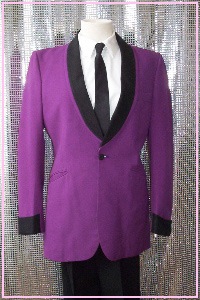
The salesman stumbles into the back room of the retail store, his suit in tatters. His co-worker exclaims “Are you all right?- What happened to you?” . The salesman replies; “Well I finally sold that purple suit we have been trying to unload for years”

Light-Purple-Jkt

The Co-worker replies “The customer hated it and attacked you?”. “No”, the salesman replies “he loved the suit, perfect fit, loved the material but his seeing-eye dog wasn’t so fond of it”.

Integrity in the deal. In means more than honesty, “How about this suit, it’s purple?” That’s being honest. “This suit is purple, walking down the street people will notice you and some will think because of the color it is funny-looking. It could embarrass you.”  That’s showing integrity. It means more than you have communicated the facts honestly, it means you have thought about the potential implications and have, unsolicited, volunteered that information so your customer/client can make a fully informed decision. 

"In looking for people to hire, you look for three qualities: integrity, intelligence, and energy. And if they don’t have the first, the other two will kill you."  Warren Buffet CEO, Berkshire Hathaway

I was recently asked by a Senior Executive of a Canadian Finance Institution, how when I am employed by Microsoft could I provide unbiased architectural advice to her? It is an extremely fair question. I answered that the reason they were looking at our organization was that a large portion of the solution was based around Microsoft technology and that was the largest value of engaging us. However, I also said that if another technology was determined to be a better fit, I would openly tell her that I would step back from the process and declare a potential conflict of interest. In addition, I indicated to her that there were 2 levels of integrity protecting her, one the company I work for that genuinely wants their customers to be fully satisfied with their solution even if it is heterogeneous technology and the other level is my personal integrity. Where the issue of integrity is always bigger than one engagement. It’s the next one and the one after that, where the CxO picks up the phone and asks her if they can trust me. That is much more important.

If you really want a purple suit and that is your best-informed choice, I will be happy to fit you for one but I will tell you that you will look funny in it.


rip

Posted in Consulting Excellence | 1 Comment