The “Expert” that Obnubilates

I was asked by an attendee last week after giving a “What you need to know about OO on this project” presentation what I would recommend they read as deeper study. Once I regained my composure, (after being challenged with the impertinent thought that my 90 minute talk did not in fact reveal all the secrets of the Object Oriented software development world) I suggested one or more of the selected works of Mr. Grady Booch as a good starting point.

booch_book

While the concept of objectivism/Object Oriented  philosophy had been promulgated in the late 1950’s by Alisa Zinov’yevna Rosenbaum (more widely known as Ayn Rand), it was people like Grady Booch that crystallized the concept and gave it voice not in philosophy but in software development. What remains today IMHO the single most important positive step in software systems is not OO programming but the OO concepts and modeling techniques developed by Booch et al that allow us mere mortals to comprehend the incomprehensible.

Why is it incomprehensible?

I got coaxed/conned into participating in a psychology research experiment when I was in University(Yes, My GF at the time was a psych major). The research was essentially focused on determining how many things the human brain could track simultaneously (or dimensions). Experiment #1. They started with a basic  2-D cartesian graph (think back ..you know the XY axis thing!) then added the Z Axis (3 dimensions). All of us can picture and track 3 dimensional objects (Length/Width/Depth). They then added the fourth dimension and caused that 3D object to move through space (errantly described as the “time” dimension”). Then the 5th, 6th, 7th dimensions etc. That’s a much more difficult image to picture/track in your mind. The same testing concept was applied to a second test using a Matroyoska Dolls concept.

220px-Russian-Matroshka2

Briefly shown each different doll and of  different sizes, we were asked to recall and assemble them in our mind in order without seeing them again. Most people can do 7 (+/- 2) correctly each time. (Being an oddity I could do 14 consistently in the experiment and about 8 dimensions). My point  however is that the human mind has very well-defined limits to the degree of complexity that it can deal with before it blows a fuse.

Now consider a 100,000 function point Enterprise System in any large corporation. If it’s old, potentially 5 to 7 million lines of software code. Having trouble visualizing how much code that is?

paper x 20

It’s a bit more than 20 boxes of copy paper with printed code on every line of every page. Thousands upon thousands of programs where data and functions interface in many thousands of ways, some well documented and others long forgotten. It is simply not possible, however smart or clever you think you are, to comprehend the whole system in detail. Enter OO modeling concepts….

The Model

I will mooch the following line from Booch simply because it is excellent and it’s a much better line than I could come up with.

“In software systems… I take things that are incredibly complex and I help organizations squeeze them down so that they are not only simple, they actually disappear. The best software is invisible to the world.” – Grady Booch 2008

To deal with complexity the human mind can either aggregate or abstract. That’s about it. The best techniques and modeling systems allows us to find good ways to either aggregate or abstract the complexity to a level where the software is “invisible to the world”.  If you look at a model and can’t easily figure it out and the system it represents, you’re not stupid… It’s a bad model.

Some consultants in the IT business  seem to make their living taking the complex and making it more complex as if the test of their expertise was their ability to find the most creative ways to obnubilate the definition of the system.

It is in fact the opposite that is true.

The expert is the one that can take the complex and make it simple and relevant to the client.  Be the expert and just use the words like “obnubilate” to make fun of those that truly are not.

Posted in Consulting Excellence | 1 Comment

The Most Unusual Things Acquired on the Road.

tipsy_duck

I have had the opportunity in my career to travel extensively. More extensively than most and certainly more extensively than was healthy. (For details you can read my blog Up-in-the-air). One of the habits that is hard to break is the collecting of memento’s from the journey.

  • How can you work in Hawaii not bring back Kona Coffee and Macadamia nuts?
  • How can you work in Sante Fe, New Mexico and not acquire the worlds hottest Chili Peppers?
  • How can you work in Charlottetown, PEI and not bring back a lobster or two?
  • How can you work in Hong Kong and not acquire a Mahjong set?

or more recently a hand-carved Tipsy-Duck (above) from the Canadian Carver in Northern Ontario?

It’s hard. For the casual traveler, souvenirs are cute. For those of us who travel a great deal it sometimes becomes detritus. It is even difficult to use it in a social setting. “Hi, I’d like you to come over for dinner. I am serving Lobster with Red Hot Macadamia nuts for dinner and we can play Mahjong over Kona coffee later….” I have not had too many takers on this approach.

I have asked a few road warriors what the most unusual things they acquired on the road, some were amusing, others required treatment, others again were true collectibles but the very best ones were friendships that last a lifetime.

Posted in Musing | Leave a comment

Negotiating the Curve (part 2)

 hp_curve

In my blog Negotiating the Curve I talked about three basic techniques for framing a negotiation:

  • contrast
  • risk
  • time

But what actually makes a good negotiator? Let’s ask the one of the world’s best negotiators what he thinks. Herb Cohen says:

  • “A QUICK MIND COMBINED WITH THE PATIENCE AND ENDURANCE OF JOB.
  • THE DETERMINATION OF A SALMON SWIMMING UPSTREAM TO SPAWN, ALONG WITH THE AGILITY AND FLEXIBITY OF AN ACROBAT.
  • THE INTEGRITY OF A SUPREME COURT JUSTICE BLENDED WITH THE IMPERTURBABILITY OF BUDDHA.
  • WHILE SAYING “I DUNNO KNOW…I DON’T UNDERSTAND…COULD YOU HELP ME”, HIS OR HER BRAIN IS ACTUALLY A REPOSITORY OF THE ACCUMULATED WISDOM OF THE AGES.
  • KNOWING HOW TO USE HYPERBOLE AND EXAGGERATION WITHOUT EVER BEING THOUGHT OF AS A LIAR.
  • THOUGH INSPIRING TRUST AND RADIATING CHARM, HE OR SHE CANNOT TRUST OTHERS OR SUCCUMB TO THEIR CHARM….”

So how do you (or I) fair against Herb’s scorecard? I’ll keep it simple… give yourself Zero if you are not 100% confident with the label and One point if you are.

Quick Mind ?
Patience of Job ?
Determination of  a salmon swimming upstream ?
Agility of an Acrobat ?
Integrity of a Supreme Court Judge ?
Imperturbability ?
Intellect contains wisdom of the ages ?
Ability to use hyperbole but always be thought truthful ?
Inspire Trust ?
Radiate Charm while never succumbing to another’s ?

Your Total Score? 

It really doesn’t matter. What does matter is how you prepare for and execute in each of these areas when you are not necessarily born with these gifts.

Quick Mind We all have this. Just practice using it if necessary. (no kidding… run a practice session)
Patience of Job Never allow your response to be time boxed in the  negotiation. Take your time to consider responses carefully.
Determination of  a salmon swimming upstream Be prepared for  long negotiation. Expect and plan for an extended event.
Agility of an Acrobat Understand going in the areas of flexibility and be prepared to be flexible on these points.
Integrity of a Supreme Court Judge You might be tempted to jam the proverbial wooly toque over your client’s eyes while you put something by, but don’t ever do it. Even if it is easy. It will eventually be discovered and everyone hates being had.
Imperturbability Don’t lose your cool.  Take a break, park the item being negotiated if it gets hot. Come back to it after a success on another point.
Intellect contains wisdom of the ages Research, research, research. Know what your client needs and what they want and know the difference between the two before you ever start.
Ability to use hyperbole but always be thought truthful Be truthful in everything and you will be thought truthful. When you need a magic wand, introduce it as such, not as a real solution.
”if you had  magic wand, I would like to see the following happen….”
Inspire Trust Trust is earned not given. Trust is earned by showing integrity in the process and that you are trustworthy.You inspire trust when there sufficient deposits made in the bank, to believe the next one is also secure. Build trust by showing each transaction, no matter how small is safe.
Radiate Charm while never succumbing to another’s It is a simple fact that people like to do business with people they like. Take time to build rapport. You can be friendly without being transparent.
Posted in Consulting Excellence | 3 Comments

Against All Odds

Lucky-Dice--30456

Last week’s Lottomax draw in Canada had a $50 million prize. For a $5 ticket you had a 1 in 28 million chance of winning the grand prize. Yet someone did. I have been on projects where:

  • the regression test just had to be 100% clean the first time, and it was
  • the person you didn’t have time to interview,you took a chance on just their CV and they turned out to be a  star
  • the client that after you explain why you need this $4 million change order says “ok, let me sign it”
  • you chat with an unknown seat-mate in a cross country flight and at the end of the flight you have a new multi-million dollar project and a long term friend.

So it’s just pure luck. Or is it?

That regression test was the product of good team work, a good quality culture and good engineering discipline. That CV was well written, honest and the reader was getting skilled at looking for the key points and assessing veracity. The client that approved that change order without a fuss, trusts you and your judgment and you had already earned that decision. The 5 hours on a flight wasn’t just idle chatter. It involved rapport building, some quality consulting insights and appropriate influencing.  None of them are really luck.

In consulting there is no Lottomax win scenario. Our success is defined by our skill that is built on a foundation of personal and corporate integrity. That’s what makes us successful against all odds.

Posted in Consulting Excellence | 1 Comment

The Realities of the Consulting Role

Dice%202

The tips, techniques and advice of this blog are all directed at developing consulting excellence. However, you won’t win them all. There are and have been some truly extraordinary business leaders and consultants in the world, that have accomplished feats through brilliance, tenacity and excellence in many areas. They still crash and burn every once in a while.

One of my favorite business people that I was introduced to in the late 80’s was Sir John Harvey Jones. Sir John is credited with the spectacular turn around of the giant ICI chemical corporation in the UK. A turn-around from near bankruptcy to producing the most profit of any UK corporation in history. My favorite Sir John story is the first company meeting after he took the helm of ICI. Employees from all over were invited to attend an outdoor conference at the ICI headquarters. There was a pond in front of the headquarters where Sir John ordered the placement of acrylic blocks just inches below the surface. At the start of the meeting Sir John walked past the speaker’s podium and walked to the centre of the pond, appearing to be walking across the surface of the water. He yelled through his mike. “This is what we are going to do. We’re going to perform miracles with this company. Miracles in research, miracles in production and miracles in sales to the world….” to a standing ovation. He passion was contagious, his drive unyielding and he inspired thousands to one of the most dramatic business turnarounds in history. His knighthood was well deserved in my opinion.

BBC had the idea to leverage Sir John in a BBC series called “The Troubleshooter”. The idea was for Sir John to repeat his performance at ICI except this time in front of a camera and for other iconic British companies. Could he consult to them and make them more successful?

The answer was yes except for one, the Morgan Car Company. This engagement brought to life the potential challenge you face as a consultant on every project. Can you be successful if you are constrained within the client’s own values, processes and motives?

Sometimes there is a misalignment that will be fatal to the engagement. In the case of Morgan, one such misalignment was that Sir John after viewing their manufacturing process determined that some automation in the process would allow them to reduce costs, increase production and drive top line and bottom line growth for the company. Morgan on the other hand felt that the hand-built nature of the car was its largest selling point and any change at all could destroy the magic that had kept the car company going for decades and decades. An impass.

I have worked on engagements where what the client stated they wanted and actually were prepared to implement were almost polar opposites.

  • They “wanted” collaboration tools but would not allow a collaboration team site to work on documents
  • They “wanted” to empower the end-user but would not let them have access to data
  • They “wanted” lights-out data centre operation and cost reductions but wanted to keep every headcount in place.

In some cases clients attend one too many vendor presentations, engage in the process of implementing a solution and have no plan to really address the consequences of the solution. So the consultant may be off on mission impossible. So if you hit the wall what can you do?

First of all the consultant/client relationship is more persistent than a single project/engagement. A fatal mismatch in objectives will terminate the project and may terminate the relationship. One thing is certain, if you can’t fix the relationship, you certainly cannot fix the project.

  • Recognize that success is most likely when you both work together
  • Both acknowledge that the quality of the relationship is crucial to the success of the assignment
  • Make a discussion of the relationship a part of the initial contact with the client
  • Discuss with your client specific examples of effective client behavior
  • Agree with your client how to monitor the relationship
  • Be willing to invest both the time and the care that this relationship will require
  • Do not ignore the realities and do not leave it to chance. Raise the issue and talk about it.
  • Talk through the misalignment.
    • decide on a realignment or
    • decide to stop

In the case of Sir John he made a number of attempts to influence, cajole and persuade Morgan to listen but was never able to get the relationship to a point where he could have the discussion openly with Moran with mutual respect.

The reality of the consulting role is that sometimes you won’t win on a project, but you don’t ever need to lose the client.

Posted in Consulting Excellence | 1 Comment

The “Sin” of Omission

inside

There was a Scottish preacher named  George B. Duncan from whom I had heard a sermon recorded back in the 1970’s somewhere. It was one of those things that you read, you hear or you see at various points in your life that simply sticks with you forever. There is a  line in this particular sermon that could have been from any religion or humanist philosophy in the world and I believe it would still ring true, in some way, for most of them.  The line is this.

The sins of commission are not the worst sins in the world. It is the sins of omission. What you could have done, had the capability, resources, capacity and time to do but you  just didn’t do it. These are by far the most heinous sins.

If you’re not a fan of old Scottish preachers, I can restate it like this:

Making a mistake or doing something bad is not the worst thing you can do. It’s doing nothing at all when you have the opportunity and capability to help. That’s the worst.

If you believe the statement above, it changes the way you look at the world and your profession. I think about this line when I watch the news about the floods in Pakistan, Cholera in Haiti (yes you should send a cheque too!) and  when I  see a project that is not mine starting to shake off the rails and tip over.  Would I be correct in saying that most consultants these days, if it wasn’t their project would just watch it crash? Would I also be correct in saying that some consultants these days, if it was their project they would still just watch it crash? I  wonder.

Some years ago I was contracted to audit a project and as a first step I reviewed an architectural design document that was, for the most part, utter fiction and bad fiction at that. The signatories to the approval of the document were all pretty much around so I asked each one if they thought the design proposed in this document was valid and if it would work. Some said yes but the best people, the ones with real world experience uniformly said: “No, no chance”. Yet they had all let the design go by unchallenged. They omitted to speak, the “sin” of omission. We fixed the project but it was some months later and millions of additional dollars were spent to modify the architecture and reengineer components where the original design had been fatally flawed.

  • “It’s SEP” (Somebody Else’s Problem)
  • “I don’t want to rock the boat”
  • “It will sort itself out eventually anyway”
  • “It’s not in my mandate”

I heard all of these comments from the highly competent resources.

Imagine for the moment that you are a plumber. A home owner has called you in to fix a leaky kitchen faucet. You go down to the basement to turn the water off and you notice that the main line to the bathroom is heavily corroded and dripping water. Every professional plumber on the planet will tell the homeowner about the other problem and recommend they fix it. They will not wait for the pipe to burst and the flood damage to occur.  Perhaps we need to raise the professional standard for the IT consultant to at least the level of Joe the Plumber and consistently tell people about leaky pipes when we see them.

Posted in Consulting Excellence | 1 Comment

The Courage of My Evictions

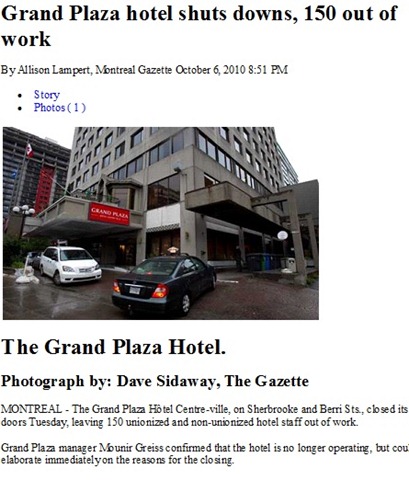
As much as possible I try to maintain some sense of normalcy when I am working on projects remotely. One approach I use is to rent a furnished apartment instead of the persistent check-in/check-out at hotels. On my current project in Montreal I rented a small but nicely appointed apartment near the St. Denis area of Montreal with over 500 restaurants in a 10 block radius from the apartment, great parks, entertainment and a few blocks from Old Montreal. There were 6 floors of furnished apartments which were the bottom 6 floors of a 20 story Hotel complex.  I returned to my apartment one night at about 7 pm. Oddly the lobby door was locked a bit early, but I used my key and ascended to my room. It was quiet, but being a tuesday perhaps not too unusual.  I caught up on emails, wrote  a report, made some dinner and then retired for the night, channel surfing through the stations. I pause momentarily as a picture of my apartment appears on one of the local french language news channels…. I missed the story but went to the internet to find…

gplaz

Well that explains why it was quiet! The next morning walking out through the silent empty corridors was like a scene from  The Shining where I half expected Jack Nicholson to round the corner with “Here’s Johnny!!”. The part that amazed me was that someone had the forethought to call the news crews from TV and Newspapers, but missed the little point of telling the guests.  However the closure became more obvious with the lack of elevator service etc.  It was a little bit like being evicted, without your landlord  actually telling you.

A few days later, I am evicted again. This time from spaces.live.com the site that has been home to my blog since its inception. The hoster is of course… the company I work for. I signed on to find a curt, polite message that said I could transfer my site to wordpress or delete it. No explanation, just an ultimatum. Evicted again, this time by my blog-site landlord.

It seems like  trend. Anyway, no consulting excellence blog today just some random rants and the desire to summon the courage of my evictions to carry on.

Posted in Musing | 2 Comments

Consultants With Benefits

cba_mug

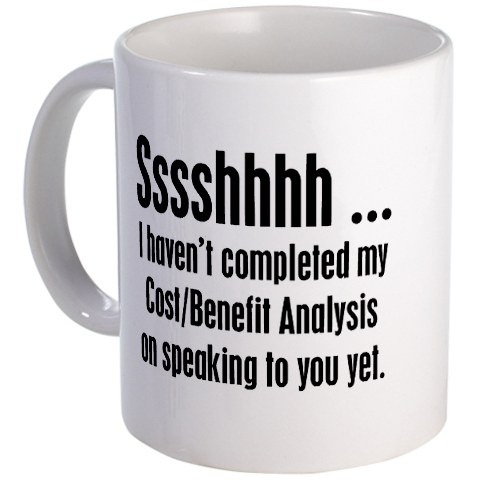
Your client will no doubt want to develop a business case for their new system. They will want to understand the costs and the benefits to be derived from the implementation. Most business cases fail to accurately represent both the real costs and true benefits of  solution. Yet year after year, clients continue to produce these works of art. They are generally flawed in two ways:

  • they are unable to correctly quantify how a really good solution will enable their business to evolve and grow
  • they are equally unable to state what the plan is to ensure that expected benefits are actually realized. (ie. you increase employee productivity, but what did you do with the time?)

There are really only 2 reasons why your client  would invest  millions of dollars in a new system.

  • they have to
  • they want to

When they have to replace a system, the cost benefits analysis (CBA) is mostly meaningless. The decision has already been made, they must replace the system. The only decision now is how much or how little money they are going to spend to do it.

  • The system is old, written in assembler and their last assembler programmer retired last year.
  • It fails regularly, idling their business.
  • It prevents them from being competitive or worse yet prevents them from being market relevant.

When they want to replace a system, the only thing that really matters is the benefits. They are not looking for the lowest cost solution, they are looking for the solution that will drive the maximum benefit:

  • to differentiate them
  • to make them better than everyone else

Hence the benefits conundrum. One of the fastest growing segments of the IT industry is the premium packaged solution space. These are the SAP’s ,Siebel’s  and the PeopleSoft’s of the world. These ultra expensive solution sets let your client invest millions of dollars just to be like everybody else.  In fact that seems to be the package vendors’ very selling strategy.

It would seem to me that if they have to replace their system, they should be cost focused, looking at the Great Plains of the world to replace their ERP.  Does anybody actually think that the 2 systems actually produce  meaningfully different income statements or accounts payable reports?  There are many SAP implementations worldwide that have cost hundreds of millions of dollars to implement. Think about the sanity of that for a moment, if it’s not going to drive unique business benefits… at least do it cheaper.

Ancillary to that thought is that if they want to replace their system, why would they want to install application packages? These are the same packages that their competitors run and by definition provides no competitive advantage. At best, it levels the playing field.

Back in the 80’s organizations legitimately used technology for competitive advantage. Today customers often use these words but then install a package that makes everyone using it live with a lowest common denominator solution. True competitive advantage and  differentiation only comes through fresh thinking, fresh business strategies, fresh products and systems that help bring those unique business strategies to life. 

New systems generate true benefit when they amplify the unique strengths and assets of the organization that uses it.  You need to instill confidence in your client that they should never be afraid to build something that is unique to them. More often than not customers with helpful coaching from “experts” will expound a “buy versus build” strategy.  However I think the statement is dangerous without better defining  the statement.

  • Buy Commodities and pay the least possible for them. (ie. Accounts Payable system and go buy it on a cloud somewhere)
  • Build systems that build your business. Be different, Be better… Build.

As a consultant I am never afraid of telling a client to build. Today we can build with incredible speed and quality. We can not only build systems that do the job, but we can build systems that can do the job much, much better than a package solution ever could. In fact given the scale of some of the SAP “package” implementations that have been done, I would say we could even build many custom solutions for less. Imagine if you would, the system acquisition as a car. A Honda Accord is your starting point. Now you would like to race it and win in the Montreal Grand prix. You can start with the Accord and modify it to be a Grand Prix car, but it will cost more, take longer and ultimately you will lose the race against a custom built Grand Prix car. The custom solution is always designed from day 1 to win.

If your client  has to replace their systems, then by all means buy a package but if they want to replace their system, tell them to not be afraid of building an asset that will differentiate and drive their business forward.

Posted in Consulting Excellence | 1 Comment

Life in the Gutters

gutter

I was recently introduced to a very nice elderly lady who a short time ago changed the course of her life accidentally. She is over 80 years of age and has lived in the same house for many decades. Each fall the eavestroughs would fill with the colourful by-products of the trees in her yard and each fall she would get a ladder and clear them away before the winter snow and  rains began.  Last fall on the yearly duty, she fell from the ladder breaking a number of bones and puncturing a lung. The bones have healed, the lung has never recovered leaving her breathless at the smallest exertion and turning her previously active life to a sedentary one. Her error? Taking on more than she was legitimately capable of.

As consultants we are often challenged and that is both expected and appropriate for the profession. But when is the challenge just too much, the danger too high and the probability of failure just too great?

I have run large projects with budgets in excess of $300 million and  teams of nearly 500 people. It wasn’t my first project. Not even close as a matter of fact. That project was taken on after more than a decade of progressively larger projects where I had demonstrated capability to take on the next big challenge.

Today I regularly find consultants who have the requisite ego to take on a project of that scale but in reality lack the skills and capability to be successful. It doesn’t seem to stop them though from climbing up that ladder anxious to experience life in the gutters.

So how do you know the difference between being professionally timid, shying away from opportunities for growth and being reckless, putting yourself and perhaps your client’s project in deep peril?

Perhaps I can provide some guidance for you.

Research the role

  • Talk to another consultant that has “been there – done that”. Ask them what their biggest learnings were during the project what their experience was prior to the project and what skills they would consider mandatory for success.  Park your ego for a moment as ask yourself honestly if you have those skills, how have you demonstrated them and on a scale of “just learning” to “writing books on the topic” how you would personally rate yourself and how would your colleagues rate you?

“What if?” the opportunity

  • Ask yourself “What if I fail?” . Now every $20 self-help book will decry this approach as being self-defeating and discouraging. I disagree, I have fired many more optimists than pessimists from my projects. There are two questions you must ask about project failure.
    • what will it do to my client?
    • what will it do to me? Will a failure ruin my reputation, track record or perhaps even worse?

If you analyzed the above you would see 

  • what the potential (if any) capability gap there is between the expected performance in role and what you know today. You now have the information to decide if that gap represents material risk to your client. If you ever are putting your client at risk of catastrophic failure don’t even think about it.
  • whether the risk of taking on the role is worth it to you.

I would always encourage people to interview for the more challenging roles (note that I did not say more senior roles). It will provide a market assessment to you and may even result in an offer. However don’t confuse your prospective client’s willingness to contract you with your responsibility to say no if you are not convinced of the probability of success for you both.

On a past engagement I watched as a consultant with the role of  Architect made major decisions without the depth of knowledge or experience to know what the ramifications of those decisions will be. I tried to be a coach and mentor but there are some that just have to see the ground rushing up to their face to get the point. It will no doubt be another blog some months from now when the pending carnage becomes professionally newsworthy.

Posted in Consulting Excellence | 1 Comment

What does it take to make a big change?

In July 1988 a Natural Gas drilling platform called the Piper Alpha caught fire. It was one of the worst oil rig disasters of all time.

Olieprod_rplatform_in_nevel

 _44808770_piperalpha512


Video – Piper Alpha Fire 

The Helicopter pad of the Piper Alpha was 170 feet above the frigid surface of the North Sea. When the fire broke out many people tried to escape the inferno but were trapped by the exploding natural gas. 167 people perished in the fire, but some survived.  A group of  14 workers battled through the smoke and flames to make it to the Helicopter pad in hopes of rescue. The fires grew larger and eventually consumed the helicopter pad completely. One person survived. He jumped 170 feet from the platform, with no survival suit into the North Atlantic. He was interviewed in an Aberdeen Scotland hospital the next day. The question was

“How could you do it? Jump 170 feet from the platform into the freezing North Sea?”

The answer

“The decision was really made for me… it’s was either fry or jump, so I jumped” (quote at 2:56 on the above video)

The Burning Platform Problem.

To be successful in making a big change, for example change of a client’s core systems or processes, you must have a burning platform. A state where the cost of maintaining the status quo is prohibitively high. You have to jump.

If you don’t have a burning platform the natural human instincts take over. Stay on the helicopter pad, wait for rescue. We’ll be safe here. Large scale systems cause massive organizational change. It effects how everyone does their day-to-day jobs, it may change their roles, their compensation and their value to the organization. To provide an example, let’s assume that a certain process (ie. production scheduling) is very complex and perhaps even more an art form than a science. Bob, the scheduler has been working at ABC company for 30 years, he is the defined expert in this area. He is highly respected by all and the President regularly walks by and says to Bob, “I don’t know how we would run this place without you!". Now the company has grown. There are more manufacturing plants than there are “Bobs” and they need a new system end-to-end to support their growth.

Ask yourself this question. If you were Bob, how much support will you give the new system initiative?  If Bob looks from his perspective, his highly valued position in the organization is in jeopardy but if he thinks from a corporate perspective and see’s he is on a burning platform, he will jump.

President – “I’d like you all to participate with the consultants to put in the new system.”

President – “We are growing fast. So fast in fact we are getting into trouble. We don’t have enough experienced people in all of our plants, to do the great work we could do when the company was small. Our customer’s are getting upset because we aren’t delivering on time. It’s do or die. Our future depends on your ability to put all the great knowledge you have into the new system, so that others can benefit from your experience and knowledge and we as a company can survive our growth.”

The role of your client’s leadership is to articulate the burning platform. To make it clear that the the entire organization needs to jump, that the risks are worth it and perhaps most importantly, there is no Plan B.

A client may or may not have ever seen a company-wide system implementation. As consultants, we have. Part of our responsibility for the solution is technical but there is more to it than that as the system isn’t a success unless the client see’s the promised benefits through the full adoption and productive use of the solution. Our role is to encourage our clients to not focus solely with the technical implementation, but to also recognize that for a solution to be successful their people need to be willing to make the jump.

So tell your client …What does it take to make a big change? A burning platform.

When the President was ready to announce the project, he rented a local theatre and invited the the entire company to get a preview of the future. The future system. The purpose:

  • to communicate a vision,
  • to get buy-in to a multi-year project,
  • to ask for input, participation,
  • to start the process of organizational change that will reinvent the company and
  • to set the current platform on fire.
Posted in Consulting Excellence | 2 Comments