Giving Bad News and Feedback to your client

A prodigious client of mine once gave me this advice. “I want bad news fast and good news very slowly”. It’s good advice. Most consultants fret about giving their client bad news, they delay or worse yet they never communicate it, leaving it for the client to discover the truth on their own. Both of those situations are potentially catastrophic for a consultant/client relationship.

  • “Why didn’t you tell me?”
  • “And you’ve known about this since when?”

These are two questions a high value-add consultant should never hear from their client.

rowing

“Guys, I have good news and bad news. The good news is that each of you will get triple rations today and a 2 hour break. The bad news is the captain wants to go water-skiing before lunch”

The Bad News

Some common themes that consultants may have seen on projects are:

  • The initial estimate was wrong and the schedule has been impacted
  • The expected productivity hasn’t occurred and you are behind schedule
  • A critical component was left out of the specification in error
  • A key resource has left the project
  • Etc.

The first thing I would say is that you have a responsibility to your client at the beginning of the engagement to talk about change. Change happens. Agree in advance that changes may occur, what you will do if it occurs and how your client wants it communicated to them. Talk about having some contingency hours set aside up front to deal with change. Even if it was 1 hour as contingency, the principal has been set that change was expected or at least possible.

The second point is to immediately communicate it to your client. It may not be in its final form but at least you have provided an early-warning to them that it’s coming. It will always be worse if you wait.

“Hi Bill, I just need to let you know that Chris has indicated that he is leaving the project. I will provide you with the date that this will occur and a recommended remedial action plan by Friday close of business. At this time I do expect this to have impact on his work area but I will have a complete impact analysis and recommendation on Friday.”

By doing so your client is now thinking at least 3 things:

  • You are on top of the issue
  • You are being forthright
  • You have provided them the maximum amount of time to start thinking about impact and contingencies

So what if you have to give your client or your client’s resources feedback?

People need both positive and negative feedback. They need to know not only what they are doing in an ineffective way, but also what they do that is effective, so that they correct the one and continue the other.

Why do many people find it difficult to give feedback to someone else?

  • They are afraid that, if they give feedback, the person will get upset
  • They are afraid that the feedback will be misunderstood.
  • They do not know how to give feedback effectively.
  • They are not sure that it is proper for them to give feedback to a client.

How do people commonly react to negative feedback?

  • Choosing not to hear what is being said.
  • Doubting the other person’s motives
  • Denying the validity of the feedback data
  • Rationalizing to explain why he or she behaved that way
  • Attacking the person giving the feedback

So it is the worst of all possible situations. You don’t want to give the feedback and the client or client resource doesn’t want to hear it. However, that doesn’t let you off the hook. If the issue is impairing your ability to execute the engagement properly or providing deliverables that are below expectations, then you must deal with it.

So here are some tips for giving feedback.

  • Be objective: “When we reviewed the QA stats, your bug ratio was about 12%, 6% higher than other team members”
  • Be specific: “It appears to be in caused by using custom code instead of leveraging our standard libraries for items such as exception handling”
  • Be clear: “At this time, we need to work together to get your code quality in-line with the rest of the team’s performance and we will do that by having Greta work with you for a couple of days and show you some pointers”
  • Be constructive: “If you do this, I am certain the code quality will come up and you can be right in there with our key developers”
  • Be sensitive: “Don’t worry about this, I just want to help you improve. There is only benefit for your professional development by being exposed to the best practices with the library usage.“
  • Be alone with them. Never give feedback publically.

Effective

Ineffective

At a peer level

Superior

With commitment

Vague

Constructive

Done with Malice

Clear

Veiled or unclear

Communicated and Listening

One way communication

Spend the time to do it right

Rushed or an “off-hand” comment


Remember, feedback is given to help other people develop/change, not to make them wrong or feel inadequate.

dunce

The most effective feedback is when the receiver has asked for it – rather than being imposed by the giver.

Therefore, it is best to ask “Is it okay if I give you some good feedback that could help you ?”

99.9% of people will answer yes.

I  will also provide the same caution as I did in my blog Mastering the Art of Influence

** Warning: The above technique if ever applied during a relationship such as partner, spouse, sig. other etc. is at your own peril and is recommended for consultant/client interactions only.
Posted in Consulting Excellence | 2 Comments

What’s your favorite position?

ceo_posit

High value consultants when completing an engagement leave the client with the capability to continue to operate successfully after they leave.  In order to facilitate this capability within your client, you may need to take many positions or roles during the engagement. These include:

  • Doer – The person who executes the work
  • Delegator – The person who engages others to do the work.
  • Coordinator – The person who plans people, resources and time to complete to work and to also plan what happens after the consultants leave
  • Champion – The person who takes the lead in the engagement, setting the vision, goals and motivates those around him or her to engage in the completion of the work.
  • Catalyst – The person who causes the optimum use of people or resources to move the project at a higher velocity.
  • Coach – The person who works with team members to provide guidance and helpful feedback on performance.
  • Facilitator – The person who finds and provides the required resources for the project to be successful and acts as a convergence point for team communication, processes and decision making to ensure they are done effectively.
  • Partner – The person who works side by side with client resources, an integral part of every key team activity and decision.
  • Teacher – The person who instructs team members in technology or process to enable their participation in project tasks and deliverables.
  • Mentor – The person who works with individual team members to provide personal coaching, personal training and learn-by-example opportunities.

What’s your favorite position?

Most of us naturally gravitate to certain positions or roles in a project. We may like being the Mentor but not like being the delegator. We may like being the doer but our patience may run thin being the teacher. To be the highest value consultant, we must be able to perform effectively in all of the positions on a project by project basis. When the project requires a coach, you need to know how to be an excellent coach. When the project requires a catalyst you need to know how to be a catalyst. While you may have a favorite position, your ability to perform well in multiple positions will ultimately determine just how satisfied your client is.  Commodity consultants are primarily “DOERS”. It is the only role they take on the project and thus their overall value is diminished.

Let’s look at a few tips for 2 of the more difficult of these positions.

Delegator

When to do it

  • Is there someone else who has (or can be given) the necessary information or expertise to complete the task?
  • Does the task provide an opportunity to grow and develop another person’s skills?
  • Is this a task that will recur after you leave the engagement and they need to learn it?
  • Is your best value for your client on another task?
  • If it is done poorly can you recover from it?

How to do it

  • Be specific about  the desired outcome.
  • Clearly identify boundaries. (Please install this software package, but do not put it in global production)
  • Provide adequate support, and be available to answer questions.
  • Agree on a schedule of checkpoints at which you’ll review progress.
  • Take time to review all work and of course be constructive in any feedback. (learn how to do this well)

Champion

When to do it

  • When there is no client champion and
  • you have discussed the role with your client and
  • the client wants you to do it. 

How to do it

  • Ensure the vision, goals and objectives are crystal clear to you.
  • Validate them with your client and ensure they 100% in sync with them
  • Communicate them broadly, deeply and often to the project team
  • Inspire and motivate the team to achieve those objectives (you might want to read my book for this one)

Think back to engagements you have done and look at the list of positions/roles.  Were there positions you could have done on that project to have added more value? The answer is usually yes.

So on your next engagement look for opportunities to try some new positions and add more value. Don’t get stuck on just your favorite.

Posted in Consulting Excellence | 1 Comment

Thinking outside the box …

set your imagination free

I had dinner this evening with a friend that I have known and worked with for many years. He taught me many things about consulting so when he called today to say we should meet, I made room in my schedule and he drove 2 hours to meet with me. Its what old friends do. 

One of the most important things I learned from him was when we had just met and we were creating a Business Intelligence system for the State of Florida in 1992 (when nobody knew what BI was).  We had every executive of the state agency attending 1 session and 1 session only and he wanted to start it by handing them crayons and a piece of paper. These executives controlled a $9 Billion state budget and they were very conservative and senior. I pushed back and said, “no way… that’s too juvenile”. My friend insisted and then said “No.. just trust me”. I did and have ever since. There are elements of consulting that to really excel at it, you must think outside the box.

The exercise he put the executives through was visioning. Having them create their ideal world pictorially and then explaining it to us. It worked amazingly well. I have er… “borrowed” the technique for years after and taught the technique to other consultants and clients. Most recently on a BI project in British Columbia.

So thinking outside the box comes naturally to some, some it requires prescription meds and others just need to learn techniques to make it happen. But it is a requisite skill of consulting excellence.

Visioning includes exploring possibilities

Activities include:

  • Using creative thinking techniques
  • Answering the client’s “question” in as many ways as possible
  • Producing a long list of possible solutions

then Reducing Complexity

Activities include:

  • Clustering possible solutions together into a few options
  • Filtering ideas

then Refining Possible Solutions

Activities include:

  • Challenging each possible solution and discarding unworkable elements
  • Presenting to the client a set of workable solutions with specific  advantages and disadvantages and the reasons for the preferred solutions.

So how about a technique to help with exploring possibilities?

No not brainstorming, let me introduce Edward De Bono the originator of the term lateral thinking.

sixhats

“The purpose of six thinking hats is to unscramble thinking so that a thinker is able to use one thinking mode at a time – instead of trying to do everything at once. The best analogy is that of colour printing. Each colour is best printed separately and in the end they all come together. The six thinking hats method is designed to switch thinking away from the normal argument style to a map making style. This makes thinking a two stage process. The first stage is to make the map. The second stage is to choose a route on the map. If the map is good enough, the best route will often become obvious.”

Step 1

Choose topic or problem area. For example: How to lower costs? How to maximize the return on capital invested?

Step 2

Gather and record thoughts from all participants under each of the five thinking hats in turn:

  • White Hat = Facts (names, numbers, indisputable)
  • Red Hat = Emotions (I feel…)
  • Black Hat = Negatives (There is a danger that…)
  • Yellow Hat = Positive (Would not it be great if…)
  • Green Hat = Ideas (Wild, absurd, lateral…)

Step 3

  • Blue Hat = Overview (Recap, summary of next steps)

It’s a fun technique. It works very well in teams and it’ll just cost you a few hats. Go buy some and give it a try the next time you vision with a client.

There are elements of consulting that to really excel at it, you must think outside the box.

Posted in Consulting Excellence | 3 Comments

More of the pie…

consult_skill

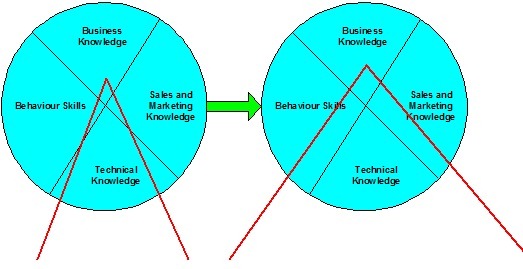
Think of IT consulting having four dimensions:

  • Technical knowledge
  • Behavioral skills (soft consulting skills, interpersonal, presentation, writing, communication, collaboration etc.)
  • Business knowledge (understanding the client’s domain/industry, terminology, processes, objectives, resource models etc.)
  • Sales and Marketing knowledge (ability to represent and “sell” the value you and your firm bring to the customer)

As you will see in the above diagram most commodity consultants today really play in 1/4 of the pie only.

  • They have technical knowledge but are usually not world-class experts in it as they tend to be more technically generic.
  • They have limited behavioral skills (They can ask questions, fill in a status report and perhaps write a design document)
  • They tend to be generic and not focused in a single domain (Healthcare, Finance, Capital Markets, Manufacturing, Energy etc.)
  • Their sole sales and marketing knowledge is perhaps creating a resume and doing an interview with the client.

or they do have all the value-consulting skills but ….

  • They have no idea how to communicate their value.

What helps in the transformation of a commodity consultant into a value-based consultant is:

  • being highly focused and very deep in a specified technical area. Know it all and know it well.
  • developing the soft client skills so not only are you effective working with your client but they truly like working with you
  • understand more of your client’s business. I am not saying to work in Healthcare IT that you need to become a medical doctor. However, you should understand the domain. What is consent? Circle of care? Healthcare Information Privacy?  Electronic Health Record? HL7 Integration? An ADT system ? An HIS system? LOINC?  ICD-9? etc. The same is true is every domain. You need to be able to speak your client’s domain language.
  • be able to understand and communicate your value. No one can do this except you. Get involved in your professional networks and build contacts. If you work through a recruiter as a value-based consultant, remember you need to convince them first as they will be the face to the prospective client until you get that first meeting.

My blog on consulting excellence will help you in 3 of the 4 areas of the the pie. Everything except technical knowledge. Technical knowledge will always be the largest part of what you do and who you are and it is up to you to figure out the best way to develop world-class expertise and depth. Let me assure you that taking and passing industry certifications is not enough. They are simply the price of admission. On a given day a large corporation recruiting for IT positions may receive thousands of resumes for a few available engagements or jobs. The ones that go to the top of the pile, have been referred by someone they already know; another consultant, an employee or a trusted (key word) recruiter. (*)  They will then sift through the pile for mandatory requirements (5 yrs with MCS* and C#, or PMI certified). If you don’t have the basic qualifications then you will be relegated to the “we’ll look at this pile if we can’t find our candidate in the first one” pile. How do I know this? I’ve  done it for literally hundreds of hires.

(*) A recruiter that is trusted by the client is worth their weight in gold to the client and to you.  They only present candidates they know are a good fit because they have taken the time to meet with the client and the consultant and ask the right questions about the role and expectations of the value to be delivered. Working out of Toronto Canada for a portion of my career, I can state that there are likely over 100 IT recruiting firms in the city. I trust 2 of them (Planet4IT is one) and I know their clients also trust them because I have been a client. If you are going to use a recruiter be very selective and check their references carefully. Without you, there is no them. The reverse is not true.

Industry certifications are just the starting point. It is the bar by which the administrator in the HR department, who is not necessarily familiar with the detailed  project requirements of the role, is set.  They will process your resume accordingly.  Now you get an interview and need to show more. Everyone who got through to an interview by definition fit the mandatory requirements. Now it’s time to differentiate.

To differentiate technically, you need extra expertise that is relevant to the client’s project. Stay current. Read the technical journals and understand the best practices, the tips and tricks and understand the pitfalls of certain approaches. Even if you have not done that specific thing yet on a project, by researching and being able to talk about different approaches you are differentiating yourself from the others. For me, on a normal week, it’s a minimum of 5 hours added to my weekly work schedule. It’s just part of earning and retaining the title of professional.

Your technical knowledge will always be the foundation of why you are engaged. However your total value is the sum of technical know-how + consulting skills + domain knowledge/experience and the only way you can get that value recognized is to learn how to communicate it.

Go for a bigger slice of the pie.

Posted in Consulting Excellence | 2 Comments

What’s your right rate?

A challenge faced by every consultant is setting their rate. A few of us are in the business for charity (or so it would seem), but most of us consult for a fee to live at a reasonable standard.  As mentioned in a number of my other blogs, there are two distinct classes of consultants:

  • commodity consultants – skill set for hire at the going rate
  • value-based consultants – rate based on value delivered to the client

So let’s do the easy one first. Commodity consultants. Your value is essentially public, you can check Payscale, enter your qualifications and see where you stand against the full time employee and contract markets.  Your client’s also can use the same tools to see how much they should be paying. Rates vary by location and is fully supply and demand sensitive. Lots of consultants available with your skill set, the rate goes down.  The following is a sample based on rate to client.

Rank IT Skill IT Jobs Hrly. Average

Annual Average

1 Sr. Developer 25.80% $ 53 $ 105,000
2 Analyst 21.88% $ 27 $ 54,250
3 Business Analyst 10.55% $ 39 $ 78,750
4 Project Manager 8.01% $ 61 $ 122,500
5 Specialty Consultant 7.60% $ 49 $ 98,000
6 Java Developer 5.03% $ 53 $ 105,000
7 Tech. Architect 4.63% $ 63 $ 126,000
8 C# Developer 3.77% $ 53 $ 106,750
9 .NET Developer 3.12% $ 56 $ 112,000
10 Administrator 2.36% $ 24 $ 48,125


The selection criteria for getting these roles is generally technical qualifications and years experience.  (College/University, Certifications etc.) If you work through a recruitment agency they will take usually 18%-30% (*) of that amount for sales, marketing and administration expenses (and profit). The net result will be that  the contract rate will be more than the Full Time Employee rate paid in your area, but not by much. You are a commodity consultant. The days of standard consulting rates being 2 times salary went away with the .com bust. Commodity consultants are currently plentiful and competing with off-shore rates, so the resultant rate to you reflects that reality.

(*) You may want to read Levitt and Dubner’s  Super Freakonomics before thinking this fee is too high. Look up “pimpact” pg. 38

Value-based Consultants

When I client hires a value-based consultant there are specific expectations of work, deliverables and value that the consultant will bring. Some engagements are time and materials but more and more the engagements are becoming deliverable based.

Historically, I or the firm I work for has averaged $600,000 to $850,000 annually for my billable time and I am not the most expensive IT consultant around. Firms like McKinsey, PWC  and others, the discussion with the client starts with $250,000 to engage. There is no hourly rate in discussion, just a discussion about the value they will bring and expectations surrounding the deliverables. Doing the math on one such engagement I was involved with, the firm was averaging per resource rates over $750 per hour.

Are they worth it?

The answer is yes. If the client went out and recruited a team to look at the same problem, it might take 6 months to find the right resources and the very real risk they may not know enough to hire well.  They will have a ramp time and by the time they develop a common approach, vision, methodology, do some research a year has gone by. When you hire McKinsey, they already have the world-class experts, the research and intimate domain knowledge that you can leverage. They can accomplish in 2 months what it will take the client internally a year+ to do. It is not the resource cost that will ever be the client’s issue, it will be the slow ramp and execution time of an internal project  that prohibits them from seeing the business-value of the change or solution they are wanting to implement. If you want a change made to an ERP system, do you call McKinsey? Of course not, but when you’re  a retail bank that just purchased the assets of a sub-prime lender and need to rethink your loan and risk management systems approach? Yes. The value is evident.  Certain value with Time and Risk Mitigation.

In my blog Just because you are necessary, does that make you valuable? , we discuss some of the differentiators between commodity and value-based consultants.  With a specific reference to what your prospective client is trying to accomplish, how do the following attributes make a difference?

  • quality
  • productivity
  • domain expertise
  • track record
  • intellectual property
  • organizational depth & other backup resources
  • communication abilities
  • analytical and design capabilities
  • teamwork capabilities
  • availability
  • consistency
  • durability
  • flexibility
  • familiarity with client tools and processes
  • etc.

What does it truly mean to your client that you can reduce risk, produce higher quality, do it faster with better proven results?

Let’s look at that chart again.

Rank IT Skill IT Jobs Average Average
1 Sr. Developer (MOSS) % $ 125 $ 250,000
2 Analyst (Domain Specific) % $ 100 $ 200,000
3 Proj. Manager with Domain Experience and Same Tech % $ 150 $ 300,000
4 Project Manager (above + 10 yr track record) % $ 200 $ 400,000
5 Specialty Consultant % $ 150 $ 300,000
6 J2EE specialist with 10yrs BEA/Websphere % $ 150 $ 300,000
7 Enterprise Architect % $ 150 $ 300,000
8 Specialty App/Solutions Architect % $ 300 $ 600,000
9 Program Lead/ Chief Architect % $ 350 $ 700,000
10 MOSS Solutions Architect % $ 125 $ 250,000


So why is a Senior Moss Developer worth $125 / hour versus a generic Senior Developer at $53.  The value based consultant will be able to explain why having 1 of him or her results in faster delivery, less hours, less rework, more quality, more delight in the end-users, faster implementation, better adoption rates and the project will end up costing the client LESS because he or she is better value and they will see the benefits faster.

So why is a Specialty PM  worth $150 / hour versus a generic PM  at $61.  The value based consultant will be able to explain why having 1 of him or her results in faster delivery, less total project hours, optimized methods and processes, less rework, more quality,higher productivity team, better requirements gathering, less risk, faster implementation, better knowledge transfer, lower operating costs and the project will end up costing the client LESS because he or she is better value and they will see the benefits faster. 

A common practice today is for larger SI’s to only present blended rates to the customer, mostly because they are not properly equipped to have a value discussion. You will find large SI contracts currently quoting $90-$125 / hour blended and Off-Shore components in the $50-$70 / hour blended.

So my advice to you is this. Understand your value, very, very well. Understand exactly what benefits the client will gain from your involvement and don’t back down from the value discussion. Prove to your client why you are worth $150, $200 or $350 per hour. It’s about value unless you’re a commodity.

Ask me how many commodity consultants I will ever hire for one of my projects? Answer: Zero. I am looking for value.

Posted in Consulting Excellence | 3 Comments

Have you ever met Bill Gates?

bill-gates 

When I first joined Microsoft, this was the third most popular question people asked me behind “can you fix my PC"?” and “can you get me Office for free?”.Surprisingly the answers are yes, no and yes I have met Bill Gates.  Ever since the days of truly being amazed by Digital Research’s GEM environment and underwhelmed with version 1 of Windows, I have wanted to meet Bill Gates (1987 perhaps?), not to thank him for windows 1.0 but to tell him some improvement ideas. Later I was duly impressed with the products, the company and his leadership and sincerely wanted to shake his hand. The opportunity came in 2001 when I joined Microsoft.  Bill and I were in the same room, just him and I. I had waited for this moment but the timing didn’t seem just quite right. We were side by side, doing our business in the men’s washroom of the executive building in Redmond. Not a time to shake hands, nor a time to say just how impressed you are. So yes I have met him, but no we have not been formally introduced.

I have been involved with one project that has put me in the hallowed halls of Redmond (thanks Mayor Vic) and have had the opportunity to meet with many of Microsoft’s top executives because of it. What you learn in that process is what the word GLOBAL really means. I have been fortunate to travel the world consulting, but each project usually had a particular focus in a country. GLOBAL thinking is different. It means when I do this here, how does it replicate itself across the globe?  It is the concept or perhaps more accurately the precept of scale.

At Microsoft we are masters of scale. We make one of something and then replicate it a few hundred million times. I am not sure that any world leader, any visionary, any human that ever lived had or has  a better concept of scale than Bill Gates does.

“We started with a vision of a computer on every desk and in every home…” – Bill Gates

I am heartened by the Bill and Melinda Gates foundation and his leadership of it because of the understanding of scale. Want to take on AIDS, Malaria, Cancer, Hurricanes, Poverty,  Global Warming? You need to understand scale.

My education in scale with Microsoft began with a business proposal for a new billion dollar business. While well received, I was was asked. “sure… but how does it scale?”

I now understand what they meant.

As consultants, we tend to think much too small. Boxed in by preconceived notions, standards, expected outcomes and norms. If you really want to help your client, talk to them about scale. What if they were global, what if it that web site was multi-lingual, what if it could take payments globally? What if their customer base was truly global?

Scale.

Posted in Consulting Excellence | 3 Comments

Bear with me for a moment…as we look at advice

bear-with-me-300x204

Advice. A hiker was seeking advice on the safety of hiking a particular trail. He met an old guide and asked him whether a certain path was safe or not. The guide replied yes mostly but you do have to watch for Grizzly Bears. He went on to say that the Black Bears in the area were very timid and would not be a worry at all. He recommended that you wear a number of small bells, carry cinnamon which the sound and smell will scare the bears and to watch the area for bear droppings. The hiker thanked him and then asked another question. How do I know if it’s Grizzly or Black Bear territory? The old guide replied. Just examine the droppings. The hiker pressed on to inquire how he would know the difference. The old guide replied that the Black Bear droppings looked like any other animals but the Grizzly’s was distinctive. The Grizzly’s always had little bells in it and smelled like cinnamon.

Like the old guide we as consultants are asked to give advice every day. Some of it will be technical advice, some perhaps on process and some perhaps on people. Junior consultants tend to offer advice freely and in some cases even when it’s not solicited by their client. They also tend to forget the impact that advice might have and not fully understand how the client may act on that advice.  I have worked with clients that take my advice as one of many inputs, jointly process the inputs and come to a decision. I have also worked with clients that take my advice and implement it exactly as given, immediately and without any other input or processing. It is critical to know what your client may do with your advice.

I was working for a major insurance company in New York City that had engaged my company to assess the viability of an outsourcing proposal from an off-shore firm. We completed the analysis and had determined that overall, the proposal was solid. We identified the risk areas, recommended contingency plans but for the most part agreed that it was viable. We presented our findings and then we spent two days with the CIO discussing the best way to have an effective transition from in-house to outsource. We recommended that the minimum transition (overlap) period would be 4 months and that the outsourcer would agree to hire/transfer about 70 of the company’s key resources. The CIO posed a “what-if” question. “If I froze all changes to the system and suppose hypothetically that we were not able to encourage our people to stay during the transition period, how long would it be before the outsourcer could bring back day-to-day operations?”. The systems in question had been in operations for many years, the operations processes were impeccably documented due to the high turnover rate experienced in NYC for IT operations resources, so realistically I thought that  they could bring up steady-state operations in likely 1-2 weeks. I said so to the CIO. The following month he terminated all 800 IT employees in a single day, keeping none for transition. I was shocked. They were down for 48 hours and made their first application change 60 days later when the new development team was on-line. He saved $15 million in payroll costs for that transition period by taking the high risk approach. It may have been my advice that allowed him to choose that path. I had no idea he was even considering something that risky, but I now knew that he had posed the hypothetical question and sought advice to validate a scenario that he had not been not sharing with us.

I have had the opportunity to work with some excellent consultants over the years and a few scoundrels and I have learned lessons from both. One of the people from the latter category I will quote on the topic of advice.

“I have found the best way to give advice to your client is to find out what they want and then energetically advise them to do it.”

I wonder how many consultants are really like that. They are not trying to reach the right answer, just the one the client will like. I was interviewing for a lead role in a major project. My prospective client asked me about some of the things I would consider “mandatory” that be in place from a process and tools perspective. I listed the ones that I believed were truly mandatory and the client indicated that their organization may not be advanced enough to deal with these. The scoundrel answer is “well of course, you can work up to them but you’re right we can certainly start without investing in that”. My answer was “Well if you don’t invest in the basics, your project will fail and here’s why …” I am not sure my prospective client wanted to hear that, but it was honest, factual and above all valuable to the client.

I would recommend the following as the litmus test for giving good advice.

  • the advice is solicited or at least you have asked permission from the client to give it.
  • you have thought about the impact of the advice and have an understanding of how your client may use it
  • it is valuable to the client

Otherwise all you are doing is sending them hiking with a few bells and some cinnamon.

Posted in Consulting Excellence | 2 Comments

Professionalism above the bar

QEH_lemontrealaisbistro

Last night I had dinner at the bar of the Fairmont Queen Elizabeth Hotel in Montreal. (The Gazpacho is excellent by the way) Normally I would blog about consulting excellence but an incident occurred that I think is noteworthy on the topic of professionalism.  The bar (in the photo) has chairs on opposite sides with the bartender in the middle. In the evening, it is very classy with candles along the bar and dimly lit. A gentleman sat across from me on the other side of the bar, ordered a drink and began to read his newspaper.  He accidentally lowered the back of the newspaper into the candle on the bar and it caught fire. He didn’t notice immediately.

newsfire

The bartender did and within a second or so, grabbed another copy of the same newspaper, walked over and said “may I exchange your paper sir”, placing the burning one in the nearby sink with water and placing a new one (same publisher) in front of his guest.  The whole process concluded before I could even shout “Le journal est sur le feu!” which turned out to be completely unnecessary, perhaps 3-5 seconds in total from flame to finish. The guest started to apologize profusely and the bartender quickly stepped in with “not at all sir, it happens all the time, may I refresh your drink?”

Professionalism above the bar.

Look at what the bartender did.  He looked for a way to deal with the situation with the minimum impact to his client. He brought him the exact same newspaper to do the switch.  Quickly extinguished the burning one, without the slightest comment or fuss and then diverted the client’s conversation from an apology to “can I refresh your drink Sir?”.

Now what had happened is that someone had actually caused a fire in a crowded restaurant, a few seconds more and the newspaper would have been ablaze and potentially could have been a dramatic situation.  But the cool, fast-thinking bartender, made the whole thing a non-event except for the lingering smoke for the next 15 minutes.

What amazed me about the sequence was that his client’s well-being was so important to him. He didn’t throw a pitcher of water at him, he didn’t just grab the newspaper and submerge it, he looked for a way that would be of minimal impact and embarrassment to his client.

I wonder on IT projects if we could get the same level of empathy for our clients and always seek professionalism that’s above the bar?

Posted in Musing | Leave a comment

Being in Demand… How to make it happen

Today in Hollywood there is a good example of being in demand.  Here is the current list of Hollywood’s “most wanted”. They receive more offers for films and command more compensation on a consistent basis than any of their peers.

Of the top 20 finishers in this year’s poll, 12 have been nominated for an Academy Award. Eight have won. They have each generated top earnings for their studios on a consistent basis.  Who provided the ranking?  The survey polled over 100 top executives at all major studios, independent companies and financiers.

AKA The clients.

What is the most important thing the studio execs are looking for? Track Record. Consistent delivery of highly profitable films.

Consultancy engagement is well named. The client and the consultant agree to venture together into potentially uncharted areas. The problems they face together are often complex and the solutions tend to be multi-faceted. Consultants want to be in demand, where clients are seeking them out, hungry for their expertise. You can achieve this sooner by setting excellence and consistency as your operating standard rather than investing time in marketing your services. Setting excellence as your operating standard builds your reputation, ensures your track record and in turn leads to you receiving referrals from satisfied clients.

Nothing will matter more than your track record of excellence to keep you in demand.

There are elements of being in demand that are counter-intuitive. Some consultants might think that having the broadest possible skill set will make you more viable for more engagements.  The opposite is actually the case.

Breadth and depth of skills are orthogonal to each other. You cannot know every topic, know it deeply and better than someone else with equivalent intellect and drive,  who with a smaller scope of those topics has deep-dived to know them intimately. 

I am an architect and very well respected for my skill in this area. I can also program in a variety of languages, design OO models, design database schema and OLAP cubes etc. However, I cannot compare my skill in database design to another consultant with the same years of experience who focused exclusively on database.  They are a defined expert in this single area, as I am in architecture.  Spending time deepening my skills on database design does not make me more in demand. In fact, the time spent detracts from my ability to sustain and increase world-class architecture skills and consequently lowers the demand for my skill.

(Now I also believe the best architects are grown from real-world, hands-on understanding of the technology, but it doesn’t mean that I need to be a world-class expert in each technology domain.)

This is the part that is not readily obvious to most consultants. They believe that having  breadth and some skill in each area makes you more in demand. It actually just makes you a commodity.  Similar to thousands of other resources, no distinctive value-add and if you get the contract it will likely be because of your low price and availability.

The critical elements of being in demand are:

  • focus – don’t be a jack of all trades, focus, specialize and become technically excellent in your area of specialty and stay ahead of technology change
  • track record – watch for opportunities that will develop your skill and track record in your area of specialty and take them over other opportunities that don’t
  • excellence –  set technical and consulting excellence as your operating standard and raise the bar on every engagement
  • network – participate in , contribute to and develop the professional network in your area of specialty

Low-Demand consultants can be spotted by these signs:

  • “I am happy to do most things that are asked of me”
  • “I like to be invited to help”
  • “I can do just about anything! Just look at my resume, I’ve got a few weeks experience in a ton of areas!”

The attitude of these ordinary consultants will result in:

  • Being used as a pair of hands, brought in as needed for the shortest possible time
  • Superficial involvement
  • Projects of marginal value (commodity service)
  • Value unclear and being questioned
  • Lowest Price
  • Low influence with client

High-Demand consultants can be overheard saying:

  • “I specialize in these three areas”
  • “I always deliver, here are the two key projects just like yours.”
  • “Because I specialize, I offer my views in these areas based on my expertise”

The approach of the excellent consultant results in:

  • More rewarding and challenging work
  • Development of reputation and expertise
  • Value added clear for all to see
  • Better compensation
  • Higher influence with the client, you are an expert
  • Used at tactical and strategic levels and
  • Being in high demand.

Remember, a compass that pointed in more than one direction, would really have no point at all.

compass_small

Posted in Consulting Excellence | 5 Comments

The Chronically Perplexed Client

bush-perplexed

It must be terrible  to wake up each morning chronically perplexed. (CP)

CP is a condition which affects a broad spectrum of the population. It occurs randomly in children, adults, blue collar, white collar workers and yes even in the world’s top jobs. So you shouldn’t be overly surprised that it can afflict your client too. It comes in various forms from mild chronic perplexation (MCP)  that causes a client to “not get” proposals and makes them unable to make informed decisions in a timely manor. The more advanced stage of the condition is called Pernicious Chronic Perplexation. (PCP). Clients under the influence of PCP exhibit the following symptoms.

“PCP can cause distinct changes in awareness. At high doses, PCP can cause hallucinations.  Other effects that can occur are blurred vision, loss of balance, and dizziness. High doses can also cause effects such as delusions, paranoia, disordered thinking, a sensation of distance from one’s environment, and catatonia. Speech is often sparse and garbled. “

Oops.. nope that’s wrong. I looked up the drug phencyclidine (PCP) instead. But let’s check the similarity of the symptoms again

  • hallucinations – “we are going to deliver this by the end of the month”
  • blurred vision – project goals and objectives lose its clarity
  • loss of balance – “if everybody just works 20 hours / day, we can catch up”
  • delusions – “there are no bugs”
  • paranoia – “if we don’t get this into QA by friday, we’re all going to die”
  • disordered thinking – “lets work on X, no Y, no X”
  • distance – “wow that team over there is just so messed up” – referring to a group in your team
  • catatonia – have you heard from Bill since last thursday?
  • sparse and garbled speech – not speaking often or clearly enough.

Hmm… the similarities are striking.

However, a client under the influence of PCP is still your client. What do you do?

  1. call Dr. Phil for an intervention
  2. treat the symptoms
  3. treat the cause

The answer of course is (3) treat the cause. You are the consultant. Ultimately succeed or fail, you will be paid and then move on to the next engagement. Your client is not so fortunate. Big projects are big career risks. A failed project can effectively terminate or set-back your client’s career. So don’t be surprised if they get a little stressed or chronically perplexed if things come off the rails.

It’s simple. If you see any of the symptoms of PCP, take immediate action to determine the root cause and correct it. Most often the following are suitable corrective actions:

(In my Blog Watching for signs of project trouble I listed some early warning indicators.  Now let’s go through the list. It is very likely this is why your client has the symptoms of PCP. Here’s some ideas on how to fix it.)

  • Is management direction inconsistent or missing – get the direction set/re-set and broadly communicated 
  • Has the project leadership gone AWOL? – get all of the leaders together and committed to resolution
  • Is there anyone on your team unable to articulate the project’s goals? – make sure everyone understands the goals
  • Project management and business management seem disconnected? – hold joint sessions
  • The team lacks a commitment to clearly articulated and commonly understood goals? – influence the team to adopt a common goal
  • Team members don’t listen to one another? – use communication best practices to ensure bi-directional communication happens
  • The team is in a state of discord? – have a night out! and then resync
  • Lack of Velocity? – plan every morning – check progress every night
  • Increasing number of small slippages? – reset schedule once with everyone bought-in and only once.
  • People willing to trade quality off for schedule? – reset schedule once for quality with everyone bought-in and only once
  • Resources are being temporarily diverted to urgent matters? – crazy glue them to their chairs or have 1:1 with managers to create transparency of the impact of resource consumption
  • Limited stakeholder involvement and/or participation? – leverage informal time and opportunities to increase stakeholder participation
  • Team members lack requisite knowledge and/or skills? – time to call the game on some and crash course training for others
  • Subject matter experts are overscheduled? – optimize the use of their time , strict agenda’s and meeting outcomes and free up 20% of their time.
  • Weak change control process? – sell the reason why you need process and then be draconian about limiting change. Push change requests to the very top for approval with full transparency of impact
  • Project Status reports puzzle you? – clear, succinct and short. Document things that are worth the time to read, nothing else

But it’s not my job you say? Yes it is.  This is not one of those times when you can stand on the sidelines and be a spectator. If you do, you will be witness to a spectacular sinking. When the symptoms of PCP  are visible, it is the harbinger of failure. You need to influence the above actions and if not successful in influence then intervene directly.

The good news is that withdrawal from PCP is short with limited enduring damage. What does that mean? It means you can save both the project and your client.

Don’t let PCP ruin your client’s success. Do something about it.

I spent a number of years of my career on global “fly and fix” missions, parachuted into projects that had gone “red” and needed a fresh set of thinking to get them back on track. What you will notice is that projects in trouble are a little like a sailboat keeling over, they have lost their forward motion and just get heavier and heavier with water.  As you start to bail (making small positive changes) it will begin to right itself and the bailing will get easier and easier as you progress, If you don’t do that initial bailing, it will “turn turtle” from neglect and then sink. Don’t make the assumption that the Project Manager or Lead can do it alone. Every bit of bailing at this stage makes an enormous difference. A little bailing though and it will right itself and have the wind catch it’s sails once again.

sailboat

Posted in Consulting Excellence | 1 Comment