The Assassin of Discontent – A Great Project

In March 1963 Boeing assembled a group of engineers to create the world’s largest passenger and cargo aircraft, the Boeing 747. Almost 6 years from the day that group was formed, the first 747 took the sky on its maiden flight. How many people were in attendance? You’re right. All of them.  It was a great project.

747-first-takeoff_ip

At Boeing,staff turnover was minimal, retirements foregone, sick days few and no one knew what a labor dispute was. The reason for that was that everyone understood they were doing something great. The 747 fleet has now flown more than 3.5 billion people, more than any other aircraft ever made.

Let’s look at another mega-project; the $12 Billion 54-mile underground Waxahachie  Texas Superconducting Super Collider (SSC).

n15shaft

“The what?” you say. Yes, the R&D facility to propel High Energy Particle Physics into the next generation of discovery for Medical Diagnostic Techniques, Cancer Therapy, Superconducting Cable Technology, Very Large Scale Integrated Circuits and  a Greener world. Well those are just some of the potential pay-offs but here’s what was actually communicated to the public. “The ultimate benefits to society are not fully known at this time; however, from experience we know that there will be large payoffs”

Over $2 Billion was invested in the project since 1983 while the cost estimates for completion grew from $4 Billion to $12 Billion to complete it, many of the key scientists and researchers left for other organizations and the project was cancelled in 1993 by the US Congress and now sits abandoned.

Let’s keep in mind the 747 and the SSC.  There are four key factors to a great project.  

  747 SSC

The Challenge

Yes

Yes

The Inspiration

Yes

No

Belonging to a Team

Yes

No

The Plan  & the ability to see the win

Yes

No

Any great project has a great challenge, whether its building the world’s first jumbo or reinventing how retail lending IT works. You can create a great challenge on just about any project.  Any great project has inspiration. Boeing’s Malcolm Stamper led 50,000 people in the race to build the 747 jumbo and in four years in the middle of the build he took a single day off, one Christmas. Stamper and his Chief Engineer Joe Sutter apparently had regular face to face meetings with every engineer. There were over 5,000 engineers on the project. On a great project everyone feels they belong to a team. It is an error to scoff at the importance of a ball cap with a project logo on it or the importance of full team lunch at the achievement of a critical milestone. These types of activities build team identity, one where the people will gladly go the extra mile for the team.  Boeing has not forgotten 40+ years later with the 747-8 and others.

747 Boeing-Tanker

On a great project there is a plan visible to all on how to achieve the win. The build of the original 747 was not without its trials and tribulations. Lots of new technology needed to be invented, but within months of starting everyone knew exactly what design miracles were required and when these miracles had to be delivered.

A great project – the assassin of discontent. If you want your IT team to be content, to be eager to get into work in the morning and enjoy the work, create a great project for them to work on. Any project can have the 4 keys to make it great.

Posted in Consulting Excellence | Leave a comment

Ensuring substance not just the form of communication

spam-en-lata

A while ago I  spent 40 minutes of valuable time having a presentation broadcast to me that I had:

  • already reviewed
  • provided important commentary on the content in the hopes of revising it and
  • had that commentary subsequently ignored without feedback or comment.

The purpose of the presentation was to improve communication. The irony was not lost on me. It was a new process, that will dramatically improve the form of communication. The volume will increase, the interaction will increases and reply-all buttons will wear from fatigue. Dozens of people will set new Outlook email rules to deal with the tsunami of emails and emails will get shuttled to a folder that may or may not ever be opened. But everyone will have been communicated to and hence communication has improved.

Or has it?

The “Big 8” of  great communication rules are:

  • Have Clear Intent – Is the purpose of your communication clear to you?  Do you know exactly what the outcome is that you want to have?
  • Determine Necessary Conversations – When your intent is clear to you, do you know who the participants in the communication need to be? Design your communication to facilitate discussion with the most necessary people. If you are asking people to do something or change something, they are by definition the most necessary.
  • Get everyone on the same page to understand your intent.
  • Create your communication points and verify that your intent will be clear to the participants.
  • Create opportunities for two-way dialogue with the necessary participants.
  • Answer the question “what’s in it for me” for your participants
  • Be succinct
  • Verify understanding of the participants and make sure it lines up with your intent and that the communication was understood.

Let’s take a simple example; a consulting engagement status report.

Intent– to inform the client of status, surface risks and concerns, document important decisions that either have been taken or will be taken and to gain agreement on the schedule and resourcing of upcoming work.

Necessary Conversations  – Client (mandatory), Optionally: Client’s PM, Client’s key stakeholders, Internal stakeholders, people referenced in the report, people who will be impacted with actions scheduled in the report.

Get on the same page – Your client needs to understand from the outset that the document and surrounding process will reduce risk, enable better decision making and promote the likelihood of a successful outcome. They must be convinced that you will not waste their time, it is not just another deliverable and your intent is the have it as the focal point for the management of the engagement.

Communication Points  – The actual status report

Two-way dialogue – You can send a status report but at a minimum you must also create the opportunity for two-way communication. Example:

  • 1:1 meeting with the client within 48 hours of report release
  • Status Report conference/video call with key stakeholders to review action items and decisions
  • Group workspace for written comments on report or actions
  • Scheduled round-table meeting etc.

What’s in it for me- Any communication including a status report must provide value to the reader for the time invested in reading it.  This means that it must include items that are not already known.

Be Succinct (enough said)

Verify Understanding – Ask questions about the report to ensure that your client has understood what you intended. “Last week we made a decision about the use of the Managed Service Engine and I just wanted to  make sure you were confortable with the implications of the decision to not have Service Virtualization. What are your thoughts on not having this capability in the architecture?”

With the 8 points above looked after, there is a good chance you will actually have effective communication. Sending out a PowerPoint deck  or any other form of group asynchronous broadcast is not communication. It’s just spam.

Posted in Consulting Excellence | Tagged , | Leave a comment

Choosing your role – Just Another Eagle

eagle

A wise and perhaps a tad acerbic colleague of mine once commented on my then pending decision to change consulting companies with the following advice.

“If you stay you will always be an eagle among turkeys, but if you go you will be just another eagle.“

It was a little harsh to many of my colleagues of that time as they were in fact a highly professional and enjoyable team to work with. It was however said to make a point. The point was that if you are seeking recognition and reward, then a role that allows you to stand out from the crowd is critical.

There are many “eagle-class” performers in jobs across the world that do not receive recognition for their performance. Why? The role they have taken on simply does not permit it.

Let’s assume you are a Managing Consultant. You manage a small team of 20 resources and you also bill your time to the client in both a Subject Matter Expert and Project Lead role.

If you:

  • deliver the project on-time and on-budget
  • achieve your personal utilization and the expected project margin
  • receive good Customer Satisfaction results
  • receive good feedback from your team on your management of them
  • help them with their career and to achieve their annual performance metrics

then you have done your job. So have the other 100 Managing Consultants in the same role, who achieved the same result. They did the job that was expected of them and they did it well. They are just other eagles. They will receive the minimum amount of reward and recognition necessary to keep the role filled with competent resources within an acceptable level of attrition. That’s simply a reality of the consulting business. It’s a business with maximum returns expected to the shareholder or partnership.

So your evaluation of the role is critical to your decision to accept a new position, if recognition is an important factor to you.

When evaluating a prospective role in a consulting organization ask the following two questions:

  • can I “blow the doors off” what is expected of me? {drag car  racing lingo for a dramatic win}
  • what would happen if I do?

Don’t ask your prospective employer what defines success, ask them what gets you on-stage at the annual conference, the trip to Fiji and the $100,000 bonus and then make sure it is at least possible to achieve in the role proffered. If not, don’t take it. You will be just another eagle or worse yet just another turkey.

Posted in Consulting Excellence | Tagged , , | Leave a comment

What’s wrong with Arrogance?

GSW_DSC_billian

When you are accused of being arrogant there are three possibilities:

  • you are actually arrogant
  • your behavior is being perceived as arrogant
  • the person making the assessment is, as usual, wrong about you or the definition of the word arrogant and unqualified to make the assessment.

“This is an impressive crowd: the Have’s and Have-more’s. Some people call you the elites. I call you my base.” – President George W. Bush speaking at a Republican Party $5,000 per plate fundraiser.

Is President Bush’s comment arrogant?  Let’s check the definition:

“Arrogance has been defined as an overbearing pride evidenced by a superior manner toward inferiors, acting with  inordinate self-esteem  or a sense of being better than others”

By the definition of arrogance, it is not. He does not refer to himself, he flatters those in attendance, it is wry humor and undeniably truthful. Yet, this quote appears on the internet in many places as “the” penultimate example of arrogance. It may not actually be arrogant but it is perceived as such.

I was recently told by a superior that I was arrogant. The person who told me could provide no examples or  first hand comments when I asked for some context. However,  understanding and then fixing this is still a challenge for me to be expediently undertaken.  

Is it style?

I do have a wide range of  influencing styles that I use dependent on the situation and in some cases specifically choose to be more directive and confident in a situation where group-hugs would not necessarily achieve the timely objective the client requires. 

“Yes. Based on my experience in four other situations similar to this, I have recommended these remediation activities and similarly would suggest that you initiate those activities immediately.”

“While I have seen this issue in four other situations that are similar, your team would like to be fully comfortable with the direction chosen and therefore I think we should approach this incrementally with the formation of a working group to further analyze the situation and make  a joint recommendation for next steps. Do you agree that we should initiate a workgroup? Who do think the stakeholders should be? ….”

Commitment in execution will always be higher with a collaborative decision-making process. If you are involved in the decision, then you will have a higher degree of ownership in the actions.  (or at least that’s the MBA theory) The process will also be slower and may result in a better, worse or the same answer. I will always ask myself  this question: “Can I afford to be collaborative?”. Perhaps a better question is:”Can I afford to not be collaborative?”

Perhaps my influencing style sometimes causes a perception of arrogance?

Is it a lack of tolerance for stupidity bad ideas?

When I am asked to mentor someone, I have been told that I am a pretty good mentor. I try to show patience, expect errors and can provide sensitive coaching to help the mentee achieve their goals. Here the relationship is defined and I believe I can play the part well.

When I am in a client meeting and someone says something stupid sub-optimal,  I can usually manipulate the discussion to get the idea off the table without hurting anyone’s feelings. But not always…

In internal meetings within my own team, I always value time higher than someone’s ego. While with a client I will discuss a really bad idea for a period of time just to dispose of it gracefully, I usually do not offer the same consideration for my colleagues.

“But Ian, There’s no such thing as a bad idea!”

Let’s not kid ourselves. Yes, there are! There’s lots of really stupid bad ideas tabled in meetings every day across the globe and as consultants you and I need to determine how much time to invest in disposing of them.

Perhaps my tolerance for entertaining bad ideas is too low?

Is it just that I am arrogant?

I have :

  • done over $3 Billion in projects,
  • worked throughout the globe
  • been a CEO, a CIO, Partner, Chief Architect, Enterprise Architect, Independent Consultant and Entrepreneur
  • managed teams of hundreds of resources
  • led multiple projects of hundreds of millions of dollars
  • managed the most successful SI practice in the history of a Global System’s Integrator
  • made millions doing it
  • designed enterprise solutions and systems that are “world-class” that process transactions for billions of dollars, save lives and have incalculable benefits for a “Greener” world.
  • worked with or for every major consulting company on the planet
  • I came from the “right” University
  • I now work for Microsoft. (Itself a paragon of  humility)

So perhaps I am allowed a little arrogance. Some people come to meetings and offer opinions and recommendations on topics that they have limited knowledge of. I do not. When I provide input, it is considered and it will be based on experience. When I tell people that they ignore my advice at their own peril… it is however considered arrogant.

Things to work on…

Posted in Consulting Excellence | Tagged , , | Leave a comment

The World’s Most Expensive Consultant

Purportedly, the world’s most expensive consultant bills out at $120,000 (USD) per day. That’s $15,000 per hour or $250 per minute… and he is fully booked. He studied clarinet at the Julliard School of Music, dropped out of Columbia University and wrote a 576 page best-selling book while soaking in a bathtub.

So who commands $250 per minute for their time and why do people line up to pay it? For the answer we will need to look at Alan Greenspan, former chairman of the US Federal Reserve.

greenspan

In my blog post “Being in demand – How to make it happen” I talk about the importance of track record. Let’s look at Alan Greenspan’s.

  • 5 years as Economic Analyst at The National Industrial Conference Board
  • 33 years as Chairman of the Federal Reserve, under Presidents Ronald Reagan, George H. W. Bush, Bill Clinton and George W. Bush.
  • 3 years as Chairman of the Council of Economic Advisers under President Gerald Ford 
  • 2 years as Director of the Council on Foreign Relations
  • Corporate director for :
    • ALCOA
    • ADP
    • Capital City/ABC Networks
    • General Foods
    • JP Morgan Chase
    • Mobil Corporation
  • Awarded the Presidential Medal of Freedom
  • Awarded title  of  Commander of the French Legion of Honor
  • Awarded title Knight Commander of the British Empire

To summarize his track record; he has guided fiscal policy for the world’s largest economy successfully across multiple decades, across multiple political spectrums engaging and influencing monetary policy throughout the world through boom cycles and recessions. He has also provided executive guidance to some of the largest global companies in manufacturing, finance and consumer products.

So what can Alan Greenspan tell you in 60 seconds that is worth $250?

For that we need to look at his specialized skill set and knowledge. In my blog post “What’s your right rate?” it reinforces that specialization is another key factor that drives value and consequently improvement in billable rate.

Alan Greenspan is a macro-economist. He is not an accountant, nor  an investment banker , nor a politician nor a derivatives trader.  He has  a Bachelors degrees in economics, a Masters degree in economics and a Doctorate degree in economics from NYU.

As an economist with the  Industrial Conference Board he focused his skills on the manufacturing sector, the impacts of  international tariff trade and tax policy. He then started his own company Townsend & Greenspan, which provided for twenty years, consulting to corporations and government agencies on macro-economic decisions, risk and impact. This followed by 3 decades at the helm of the Federal Reserve.  The key point is that Alan Greenspan very likely has more specialized knowledge in the actual real-life application of economic policy than anyone else on the planet. That is why, what he can tell you in 60 seconds is worth $250, because very likely you won’t hear it anywhere else and probability of that information he gives you being right is very, very high.

Now in the IT world would there be anyone who commands $120,000 per day for consulting?

Yup. There is a consultant who was the key architect (now retired) of one of the major trading systems that has a $480,000  5 year retainer to be on-call if they have an outage. The maximum number of days service required under the retainer is 4. ($120,000 per day)  You only get that type of contract with track record and specialization to create value to the client.

Posted in Consulting Excellence | Tagged , , | 1 Comment

How to Make More Money in Consulting

ishades_soft

The “Jack of All Trades, Master of None” Consultant. This is the consultant that can write some C# code, do a bit of SQL, understand basic database design, code up a web page, knows how to build a basic web service and understands how to do this in .NET and Java and perhaps a little PHP thrown in as well. They can do just about anything, but cannot do anything very well.  They can apply for almost any development job but will always be the weak player on the team and poorest paid.  They are not a defined expert in anything.

You can look across the world as to what different cultures think of  knowing a little about a lot. In China you may hear “equipped with many knives, none are sharp” as a description of the multi-discipline consultant. Visit Argentina and you may be told “He who embraces too much, has a weak grasp of the job”  or they may comment on the consultant’s “ocean of knowledge an inch deep”. In Vietnam  and Lithuania they say it’s 9 talents, in Russia 10 talents and in Korea 12 talents but they all agree there is always 1 more talent attributed to the multi-talented consultant, a talent for starvation.

In my blog post  just because you are necessary does that make you valuable? I described some of the value differentiators that make consultants worth more to their clients. They included:

  • quality
  • productivity
  • domain expertise
  • track record
  • intellectual property
  • organizational depth & other backup resources
  • analytical and design capabilities
  • consistency 
  • familiarity with tools and processes

Now ask yourself these questions

  • How do you consistently produce the highest quality deliverables with the fewest errors and the least rework required?
  • How do you attain the highest productivity levels?
  • How do your learn not just about the basics but the nuances of an industry and apply those learning’s to better designs?
  • How do you develop a constantly improving track-record of success, productivity and quality?
  • How do bring with you both your own and knowledge of appropriate external IP to apply to your client’s solution?
  • How do you develop a network of other experts in both the technical and business domain that are there to help you out and provide insights?
  • How do you know which patterns work best for a client solution?
  • How do you develop true consistency in process and deliverables?
  • How is that you can be familiar with the development environment, requirements environments, QA environment,  Build environment, Promotion models etc.?

The answer is: You Specialize.

When you specialize , your value goes up after each engagement for the reasons above. When your quality is outstanding, it costs your client less in rework. They can afford to pay you a portion of that savings. When you can do the job at twice the speed, your client is paying 50% less than other resources. They will have a net benefit to pay more for you than the other resources.  When you know the domain, the time invested to ramp you in the industry is not required. It will not be weeks before you are productive, you are productive on day 1. The client will pay more for that advantage. When you have a track record of success in role and in projects of this type, you reduce the client’s risk. They don’t need as much governance and oversight, they can have a wider resource to PM ratio and they spend less time pulling you away from productive work to communicate process or standards. The time saved is true value to the client and you are worth more to them because of it.  When you bring your own IP or access to proven IP you act as a catalyst and accelerator to the project. Not only do you go faster, but you enable those around you to be more productive, produce higher quality outcomes and have less rework. This is of extreme value to your client. You can expedite the delivery of the project. They will gladly pay extra for this capability. No project likes surprises, when a team member delivers consistently, the risk profile is reduced and costs are avoided. It is extra value to the client. When you are familiar with  the tools, you not only avoid training time  and the productivity ramp; you are giving the client a turbo boost on day 1.

If you are a $50 or $75 per hour consultant in the North American market, you are a commodity. The client assumes:

  • your quality will be average
  • your productivity will be average
  • you don’t have specific domain expertise
  • your track record is not clear
  • you do not bring proven intellectual property to the project to share
  • you have no network of experts that can help you out if you get into trouble 
  • you have average analytical and design capabilities
  • you have average consistency
  • you will need to be trained and ramped with tools and processes

In summary, you don’t bring the required additional value to command a higher rate. The more value you bring, the more valuable you are to the client. When you specialize all of these differentiators have intrinsic value to the client. Let’s take a shot at monetizing them.

  • highest quality deliverables with the fewest errors and the least rework required – if you produce 50% less errors in a year this would result in a 12.5% FTE savings in QA.
  • highest productivity levels – if you produce at 8 Hrs/FP (expert) versus 16 Hrs/FP (average) you create a 50% FTE savings on development
  • industry knowledge and better designs – perhaps saving 1 full iteration in a design cycle – 25% FTE
  • Track record – Reduced governance from 20% overhead to 5%  overhead – 15% FTE
  • IP to apply –  Easily could impact 1 FTE to N FTE’s annually.
  • Network of other experts – Assumed that it saves 4 weeks per year in churn – 8% FTE
  • Design Pattern knowledge – easily could impact 1 FTE to N FTE annually
  • Consistency – Reduced QA governance from 20% overhead to 5% overhead – 15% FTE
  • Familiar with the environment – 2 weeks training and 3 months at 50% productivity savings – 16% FTE

So now let’s look at the net benefit to your client.  It calculates to 3.4 FTE.  At $50 an hour before, any rate below $220 / hour now is a net benefit to your client.  If  you negotiated a rate of $175 per hour, your client can pay that rate and still have a $45 per hour additional benefit advantage.

$50 an hour is $104,000 per year earnings full time. $175 per hour is $364,000 or $260,000 per year more.  Why does a client pay $260,000 a year more for you a 350% premium?

One of the main reasons is that you have specialized.

  • A commodity consultant spends his or her entire life learning less and less about more and more, until eventually he or she knows nothing about everything.
  • A premium consultant spends his or her entire life learning more and more about less and less, until eventually he or she knows everything about nothing.
  • An Architect spends his or her entire life learning more and more about more and more, until eventually he or she knows everything about everything and then writes a blog about it.
Posted in Consulting Excellence | Tagged , , , | 1 Comment

Choice–Where is your IT career going?

Tough Decisions Ahead Road Sign

“Destiny is no matter of chance. It is a matter of choice.

It is not a thing to be waited for, it is a thing to be achieved.”

William Jennings Bryan

In his memoir “Idea Man” he quotes his colleagues where he worked as a programmer “It was crazy they said, to ditch an established firm for some fly-by-night start-up … Your job’s safe here at Honeywell, they kept telling me. You can work here for years.”

Paul Allen, co-founder of Microsoft, one of Time Magazines 100 most influential people in the world and today one of the wealthiest… what if he had stayed there?

In 1982 I was in the co-op Mathematics C&O program at the University of Waterloo. I had spent a number of co-op terms building cool chemical lab application and real-time process control systems for Dow Chemical on DEC PDP, Harris and Perkin-Elmer mini-computers. Approaching the summer of 82 the US/Canada economic recession had deepened and few if any co-op students were getting placements.  I did not want to wait to see if I would go back to Dow or not (I was asked back) and decided to accept a contract job to develop a package design solution for a packaging company. Out of this effort was born my own company that ran for a number of years selling software applications to paper mills, corrugated “board” producers and box manufacturers. I got the opportunity to be a software architect, CEO, employer, work with client CEO’s across the world, be a conference speaker, lead an industry on technical innovation and make a bunch of money in the process. …. what if I had just gone back to Dow Chemical  for the last co-op work term?

Our professional careers are driven by how smart we are, how hard we work, how good we are,  our principles/ethics but to a very large extent our career choices moment by moment.

Not all of us will have Paul Allen’esque type opportunities and choices, but way too few of us take any chance at all.  Every month I meet people in IT who have brilliant entrepreneurial ideas, that could make millions and yet almost none of them ever act on them. For the people who are thinking of either:

  • getting out of the IT department and into contract consulting
  • starting your own business
  • developing something cool to sell
  • changing your career

Here are 20 career condition tests to apply, both negative and positive, before you make the leap. If some of them are true …


  • You’ve made an error that will haunt your career at your current place for a while.
  • You’ve burned your bridges with your colleagues and are not getting along well.
  • Your stress level is too high at work and it is affecting your physical or mental health
  • You feel unchallenged and underutilized.
  • You know that you are under compensated for what you do and attempts to get this remediated have failed.
  • The company is experiencing a downward financial spiral or just starting to be aimless.
  • Relationship with your boss is damaged and the effort to repair it is just too high or will take too long.
  • Your life has changed and you need to move on.
  • Your principles differ from that of the company you work for and it’s impacting your work.
  • You’ve stopped enjoying your job.
  • You have the financial strength to cover your obligations while growing a new career
  • You can sellyourself or your product to potential clients/customers
  • You know your potential client and customers
  • Extra hours and effort is not a lifestyle killing or family-threatening issue
  • Your family is supportive
  • You are convinced there is a market for your services  or product at a price-point that is profitable
  • You are highly self-disciplined
  • You can afford to fail without becoming suicidal or tearing your family apart.
  • Just the idea of the new career or product brings a smile to your face
  • You are thinking about it… everyday.

If you went through the list and made the decision to leap, just remember when you are the next Paul Allen or Bill Gates who talked you into it!

GiantLeap

Posted in Consulting Excellence | Tagged , , | Leave a comment

Leadership … Taking the lead when you need to

dog3

My daughter (working in an office job now) posed the following question on Facebook last night. “How did it come to be that stereotypical group dynamics acknowledge the loudest, most social and conversationally dominating person in the room as a leader?”  One of the responses it elicited was “Dunno, but it works for me” from a mutual friend of ours and knowing both her job (sales) and personality, I expect it does and works very well.

However the real question is when it is your JOB to lead, how do you get the leadership position without being the most social and dominating person in the room?

The first thing to remember is that in groups people naturally expect leaders to emerge. I won’t bore you with lots of “pack instinct” or other psychoanalytical theories, but they do.  So if leadership isn’t obvious, the pack gravitates to the next best thing, someone they think can be leader, normally the “loudest, most social and conversationally dominating person in the room”.

If you are charged with leading a team, recognize that the initial team meeting starts with a leadership vacuum and you need to fill it. There are 3 ways to do so:

  • example
  • position
  • permission

If you lead by example the following are the characteristics:

  • you ask more questions than you take
  • you set the agenda, the objectives, the goals or facilitate getting to them
  • you assign tasks and deliverables
  • you check status
  • you hold people accountable to what they agreed to
  • you are one that makes sure the meeting is inclusive (see my blog post series on facilitation )
  • you in effect imply that you are leader and simply do the tasks associated with it

If you lead by position then the following are the characteristics:

  • your role has been formally communicated by someone senior enough to fire and/or positively/negatively impact every participant in the room
  • they have communicated their objectives and stated that you are responsible to see that the team achieves them
  • they have communicated to the team that they expect their support of you and your success is the team’s mutual success.

(works  in some places in the world better than others….)

If you lead by permission then the following are the characteristics:

  • you have asked for and been granted by the team the role of leader
  • because they have mutually agreed, there won’t be any power-struggles

These are really the starting positions for leadership, the ending position is dependent on what you do once you have been granted the position. Your only a leader as long as someone is following. Otherwise, you’re just a person going for a walk.

As consultants we are almost never in a place where we can use position to gain a leadership role. Permission, I have found is to be the fastest and most enduring mechanism for this, and it can be this simple…

“Hi. I am Ian from …. This team has been pulled together to …(list here). I have experience in …(list here). I would like to recommend to you that I lead this team because …(list here). In that role I would do the following for the team …. Are you okay with that … (Round table person by person acknowledgment)”

Most of the time this approach works for me, not always.

Posted in Consulting Excellence | Tagged , , , , | Leave a comment

You’ve Got Mail… and more mail, and more mail and ..

email

This year marks the time where I change my CV from “20+” years of experience to “30+” years of experience as it passes 3 decades since I first transitioned from a passionate computer hobby to making real money in IT. I started with computers in the time when you were thrilled to be able to exchange emails on a BBS over an acoustically coupled 300 baud modem.  It was followed in the corporate world by IBM PROFS email (1981) which effectively eliminated the corporate paper “memo” and other’s like DEC’s ALL-IN-ONE.

Email was rare, always a treat to read and fun to show to the dinosaurs who still wrote memos on paper. Today, not so much.

Three years ago I damaged my hearing while Scuba diving in Mexico. The result was the requirement for a hearing aid in order to participate effectively in crowded meeting rooms. It has a great advantage however, you can turn down the volume…. and the world becomes a quieter place.

There are days that I would really like a similar capability to turn down the volume on email. Days where I would like to see jail terms brought in for those that know no  button to click other than REPLY-ALL. 

It is not likely that we will actually decrease email volume, but we can manage it better and as consultants must manage it better.

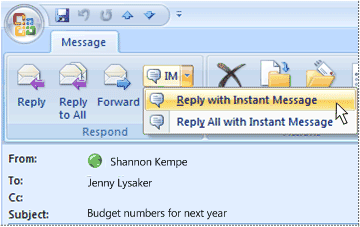
Convert messages from email to Instant Messaging/Instant VOIP where you can.

When you receive an email and its looking for a response from you, rather than establishing a ping-pong like volley of serve-return combo’s, move it direct to IM and finish the conversation right there. (VOIP is likely faster, but no record of the exchange, which is very important for client interactions)

im

* Works with Lync and just fine with Live Messenger also… (and Skype won’t be too far behind)

Prioritize client communications

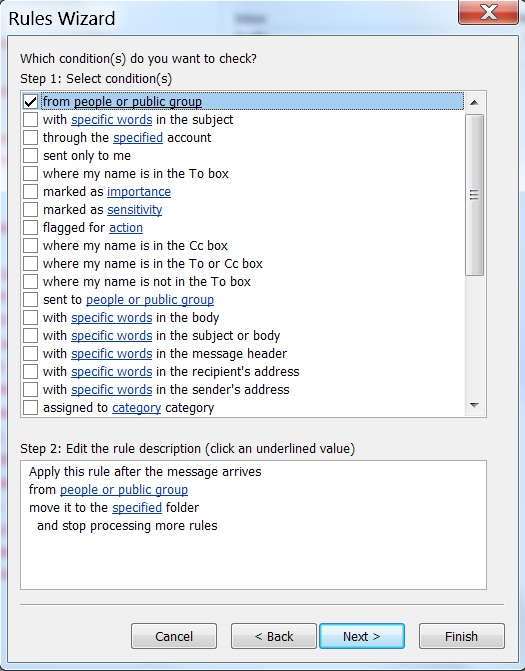
A quick tip that works for me and may work for you. You likely already add rules for filtering email into specific folders  (this has been around for a very long time)

image

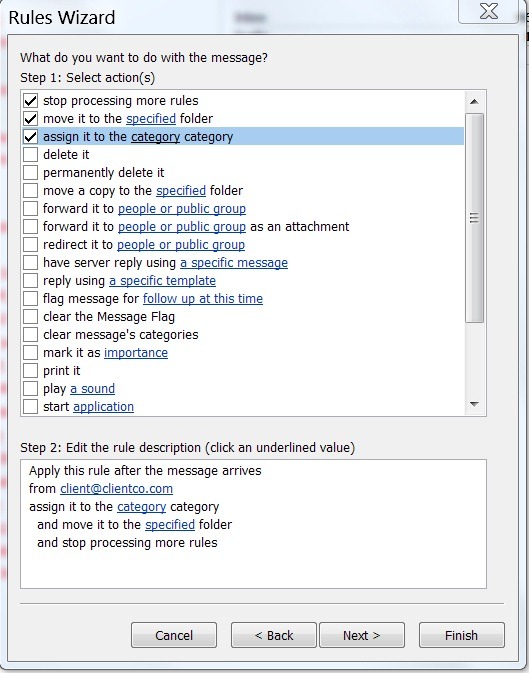
But  automatically adding categories when the email arrives to assess importance and work priority is a great way to make sure you are working through the communications in the best order.

assign

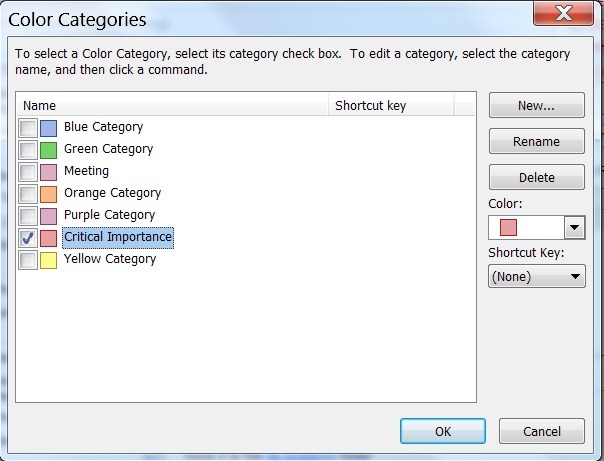
In my mail I have configured my categories as follows:

  • from my clients – red
  • from my many matrixed bosses – yellow
  • where I am the only recipient and the sender is internal – orange
  • from family & friends – green
  • references specific project name in subject – blue
  • contains “action required” or “action requested
    in the subject – purple
  • specialty discussion groups where I am active on threads – pink

cat

How-to-Video

Now at a glance I can see what’s important and filter by category with a single click.  I can’t reduce the email, but I can be sure that I spend my time wisely responding to what’s important.

Finally

Set the example.

  • IM or VOIP instead of email
  • Don’t email large files, put them on an accessible site and send the link.
  • Don’t use distribution lists unless you really need to
  • Use a forum not a distribution list for general questions and communication
  • Got something to broadcast? – Tweet it

and lastly

noreply-all

Posted in Consulting Excellence, Technology | Tagged , | Leave a comment

Kevin Turner@ Microsoft – is KT the new SteveB?

clip_image002

I was in the Microsoft office in Aug 2005 when the announcement of Kevin Turner’s (KT) appointment to COO was made. Like many others I had quizzical look when everyone found out he was from Wal-Mart and wondered what the Microsoft leadership was thinking. Five years later, the intelligence of that move is starting to become clear.

Coming from the outside KT lacked the institutional arrogance that pervaded some corners of the Microsoft campus. When you run a till at Wal-Mart, you learn up close and personal about customer service and value and then as the CIO of the same world largest company you learn about global thinking, scale and every aspect of a global company. For an encore, you run a $37B division of Wal-Mart. Yes, it’s retail but still quite a business pedigree.

I was at Kevin’s first speech to the sales troops at Microsoft and he got a lukewarm welcome. His folksy, southern charm and polite manners were lost on most of the Microsoft sales community. So he changed it. Now, no one is confused when KT speaks about what he wants, what he expects and painting a vision to get there.

The quote that sold me personally on KT and made me think that yes indeed when SteveB goes off to some foundation to turn all his energy and billions into saving the world, that KT will indeed be a natural choice.

Microsoft CIO Conference

“And if there’s anything I can do to help you, Kevin.Turner@Microsoft.com, and there’s my phone number.[pointing to the screen] I’m a resource. I know that you’ve got a lot of people that support you, but certainly I want to make sure that you know you can reach me if needed, and certainly there are things that we don’t get to here in the Q & A, I’d love to hear from you.”

It wasn’t just the quote, it was the fact that since then I had met with 3 CIO’s who called or emailed KT with an issue or question. In each case, he personally called them back within 24 hours and tracked the issue to closure, all the while running a multi-billion dollar business.

KT understands that it’s not just the products, it’s the customer and the value that Microsoft can bring. It’s a philosophy that was engrained for 19 years at Wal-Mart, that he is bringing to Microsoft and yes ….changing the culture. That was what the MS executives saw in 2005 and knew that Microsoft needed from Kevin Turner.

I was on a call with a client executive last week and they made the comment “You don’t work for Microsoft, do you?”.  I was puzzled and indicated that I joined Microsoft in 2001 to which he replied.”Well I have never heard anyone from Microsoft talk about value like that…” . Yes, we are starting to…

As consultants we can learn from KT. Every conversation he has with customers is about value, every customer relationship is sacred and you innovate your products not to sell them to your customers, but for the value your customers will get from them.

There is no question that SteveB is iconic at Microsoft but there will come a day when he is ready to sit on the board instead of the CEO’s office. If that happened, I think Microsoft has at least one good option for the next version of CEO.

Microsoft apparently thinks so too.

clip_image004

Posted in Consulting Excellence | Tagged , , | Leave a comment